 Open Notice to Quit Editor Here
Official Notice to Quit Form
The Notice to Quit form is a legal document that landlords use to inform tenants that they must vacate the rental property. This notice typically outlines the reasons for termination of the lease and provides a specific timeframe for the tenant to leave. Understanding this form is essential for both landlords and tenants to ensure a smooth transition and to comply with local laws.
The Notice to Quit form is an important document in the landlord-tenant relationship, serving as a formal request for a tenant to vacate a rental property. This form typically outlines the reasons for the eviction, which may include non-payment of rent, lease violations, or the end of a rental agreement. It also specifies the timeframe in which the tenant must leave, often dictated by state or local laws. The Notice to Quit must be delivered in a manner that complies with legal requirements, ensuring that the tenant receives proper notification. Completing this form accurately is crucial, as it can impact the eviction process. Both landlords and tenants should understand their rights and responsibilities regarding this notice to ensure a smooth transition, whether that involves moving out or addressing the issues at hand.
- Alabama
- Alaska
- Arizona
- Arkansas
- California
- Colorado
- Connecticut
- Delaware
- District of Columbia
- Florida
- Georgia
- Hawaii
- Idaho
- Illinois
- Indiana
- Iowa
- Kansas
- Kentucky
- Louisiana
- Maine
- Maryland
- Massachusetts
- Michigan
- Minnesota
- Mississippi
- Missouri
- Montana
- Nebraska
- Nevada
- New Hampshire
- New Jersey
- New Mexico
- New York
- North Carolina
- North Dakota
- Ohio
- Oklahoma
- Oregon
- Pennsylvania
- Rhode Island
- South Carolina
- South Dakota
- Tennessee
- Texas
- Utah
- Vermont
- Virginia
- Washington
- West Virginia
- Wisconsin
- Wyoming
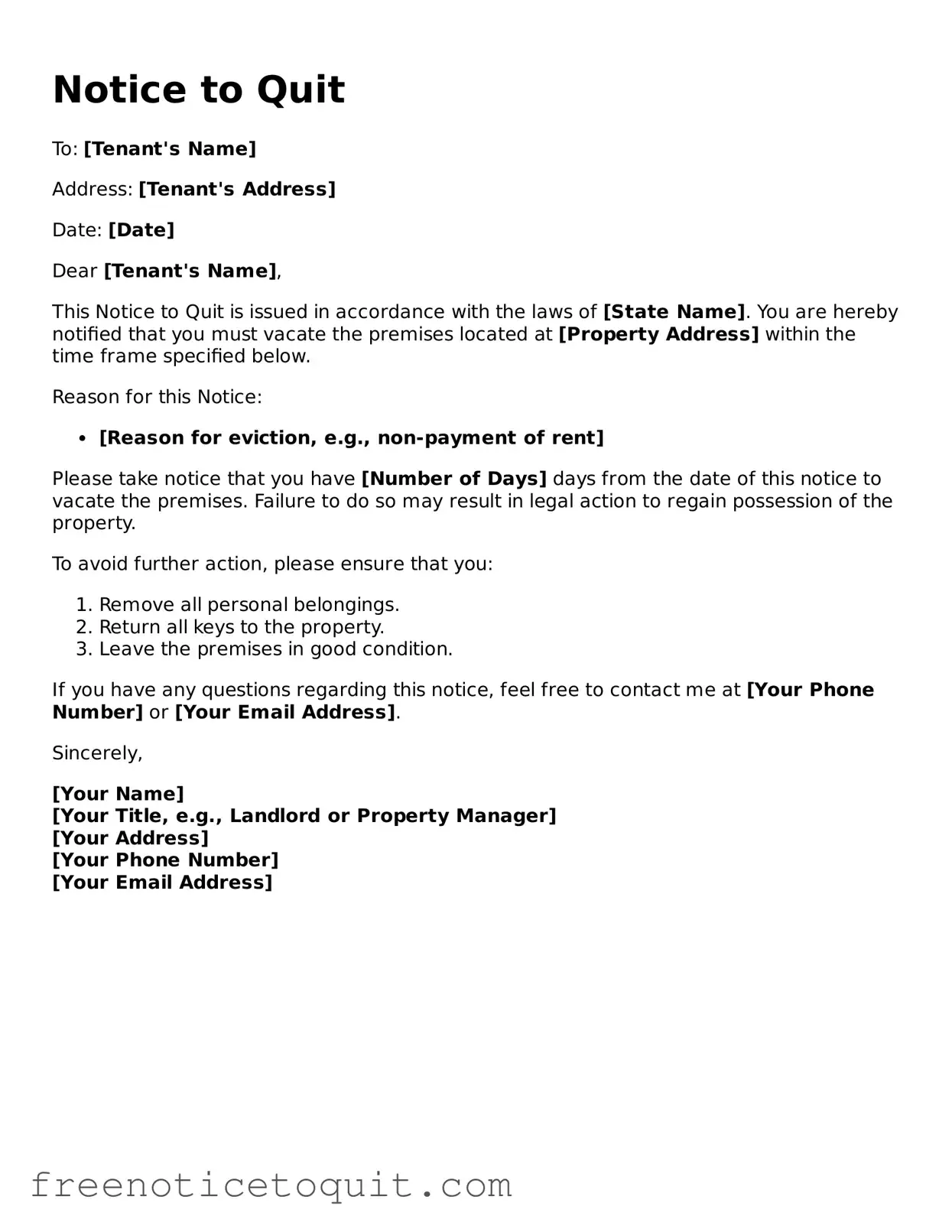
Notice to Quit Sample
Notice to Quit
To: [Tenant's Name]
Address: [Tenant's Address]
Date: [Date]
Dear [Tenant's Name],
This Notice to Quit is issued in accordance with the laws of [State Name]. You are hereby notified that you must vacate the premises located at [Property Address] within the time frame specified below.
Reason for this Notice:
- [Reason for eviction, e.g., non-payment of rent]
Please take notice that you have [Number of Days] days from the date of this notice to vacate the premises. Failure to do so may result in legal action to regain possession of the property.
To avoid further action, please ensure that you:
- Remove all personal belongings.
- Return all keys to the property.
- Leave the premises in good condition.
If you have any questions regarding this notice, feel free to contact me at [Your Phone Number] or [Your Email Address].
Sincerely,
[Your Name]
[Your Title, e.g., Landlord or Property Manager]
[Your Address]
[Your Phone Number]
[Your Email Address]
PDF Data
| Fact Name | Details |
|---|---|
| Definition | A Notice to Quit is a legal document used by landlords to terminate a lease agreement. |
| Purpose | It informs tenants that they must vacate the rental property by a specified date. |
| Common Use | Landlords typically use this form when a tenant has violated lease terms or failed to pay rent. |
| State-Specific Forms | Each state has its own requirements and forms for issuing a Notice to Quit. |
| Governing Law (California) | In California, the Notice to Quit is governed by California Civil Code § 1946. |
| Governing Law (New York) | In New York, the process is outlined in the Real Property Actions and Proceedings Law § 711. |
| Delivery Methods | The notice can be delivered in person, via certified mail, or posted on the property. |
| Timeframe | Tenants are usually given a specific period to vacate, which varies by state. |
| Consequences of Non-Compliance | If tenants do not comply, landlords may proceed with eviction proceedings in court. |
Instructions on Utilizing Notice to Quit
After completing the Notice to Quit form, you will need to ensure that it is delivered properly to the tenant. This step is crucial, as it initiates the process of addressing any lease violations or issues that may have arisen. Follow these steps to fill out the form correctly.
- Gather necessary information: Collect details such as the tenant's name, address, and the date the lease began.
- Specify the reason for the notice: Clearly state the reason for the Notice to Quit, whether it’s for non-payment of rent, lease violations, or other grounds.
- Indicate the time frame: Specify how many days the tenant has to vacate the premises, based on local laws.
- Include your information: Write your name, address, and contact information at the top of the form.
- Sign the form: Sign and date the Notice to Quit to make it official.
- Make copies: Create copies of the completed form for your records and for delivery to the tenant.
- Deliver the notice: Choose a delivery method that complies with local regulations, such as personal delivery, certified mail, or posting it on the property.
FAQ
What is a Notice to Quit form?
A Notice to Quit form is a legal document used by landlords to inform tenants that they must vacate the rental property. This notice is typically issued when a tenant has violated the terms of their lease, such as failing to pay rent or causing damage to the property. The form outlines the reason for the eviction and specifies a timeframe in which the tenant must leave.
How much notice must be given to a tenant?
The amount of notice required can vary based on state laws and the reason for the eviction. Generally, landlords must provide a minimum of 30 days' notice for non-payment of rent. However, for lease violations, the notice period may be shorter, often around 14 days. It’s essential to check local regulations to ensure compliance.
Can a tenant contest a Notice to Quit?
Yes, tenants have the right to contest a Notice to Quit. If a tenant believes the notice is unjust or that they have rectified the issue, they can respond to the landlord in writing. If the situation escalates, it may lead to a court hearing where both parties can present their case.
What happens if a tenant does not leave by the deadline?
If a tenant fails to vacate the property by the deadline specified in the Notice to Quit, the landlord may initiate eviction proceedings. This usually involves filing a lawsuit in court to obtain an official eviction order. It is important for landlords to follow the legal process, as attempting to forcibly remove a tenant without a court order can lead to legal repercussions.
Is a Notice to Quit the same as an eviction notice?
While a Notice to Quit is a type of eviction notice, it is not the final step in the eviction process. It serves as a preliminary notice that gives tenants the opportunity to rectify the situation before legal action is taken. If the tenant does not comply with the Notice to Quit, the landlord may then proceed with filing for eviction.
What should be included in a Notice to Quit form?
A properly completed Notice to Quit should include the tenant's name, the address of the rental property, the reason for the notice, and the date by which the tenant must vacate. Additionally, it should provide information on how the tenant can contact the landlord for further discussion or clarification. Clear and concise language helps ensure that the tenant understands the situation and their obligations.
Common mistakes
-
Failing to include the correct tenant information. Ensure that the tenant's full name and address are accurately filled in.
-
Not specifying the reason for the notice. Clearly state why the notice is being issued, whether for non-payment of rent or lease violations.
-
Omitting the date of the notice. Always include the date to establish a timeline for the notice period.
-
Using vague language. Be specific and clear about the issues that led to the notice. Avoid ambiguous terms.
-
Not providing the correct notice period. Ensure that the notice complies with state laws regarding how much time a tenant should be given to respond.
-
Failing to sign the notice. A signature is necessary to validate the document and show that it was issued by the landlord.
-
Not keeping a copy of the notice. Always retain a copy for your records in case of future disputes.
-
Ignoring the need for proper delivery. Make sure the notice is delivered in a manner that complies with local laws, such as by certified mail or personal delivery.
-
Not checking local laws and regulations. Each state has specific requirements for notices, so it’s important to be familiar with them.
-
Using outdated or incorrect form templates. Always use the most current version of the Notice to Quit form to avoid legal issues.
Documents used along the form
When a landlord needs to terminate a tenancy, the Notice to Quit form is an essential document. However, it is often accompanied by other forms and documents that support the eviction process or clarify the terms of the lease. Here are some commonly used forms that may accompany the Notice to Quit:
- Lease Agreement: This document outlines the terms of the rental arrangement between the landlord and tenant, including payment details, duration, and responsibilities of each party.
- Eviction Notice: This formal notification specifies the reasons for eviction, including lease violations or failure to pay rent, and may be required in some jurisdictions.
- Proof of Service: This document confirms that the Notice to Quit was delivered to the tenant, ensuring that the landlord has complied with legal requirements for notification.
- Summons and Complaint: If the eviction proceeds to court, these documents initiate the legal process, detailing the landlord's claims against the tenant.
- Affidavit of Non-Payment: This sworn statement by the landlord verifies that the tenant has not paid rent, providing evidence in court if necessary.
- Rent Ledger: A detailed record of rent payments made by the tenant, this document can help establish a pattern of payment or non-payment.
- Tenant's Response: If the tenant contests the eviction, they may file a response outlining their reasons for remaining in the property, which can impact the court's decision.
- Writ of Possession: If the eviction is granted, this court order allows the landlord to regain possession of the property, often involving local law enforcement.
Understanding these documents can help both landlords and tenants navigate the eviction process more effectively. Each form plays a critical role in ensuring that the legal proceedings are clear and compliant with local laws.
Similar forms
The Notice of Termination is a document that serves a similar purpose to the Notice to Quit. It is used by landlords to formally communicate their intention to terminate a lease agreement. This document outlines the reasons for termination, which may include non-payment of rent or lease violations. Like the Notice to Quit, it typically provides a timeframe within which the tenant must vacate the premises, ensuring that both parties are aware of their rights and responsibilities.
A Lease Termination Letter is another document akin to the Notice to Quit. This letter can be initiated by either the landlord or the tenant and signifies the end of a rental agreement. It outlines the reasons for termination and provides a clear timeline for when the lease will officially conclude. Both documents aim to provide clarity and prevent misunderstandings between the parties involved.
The Eviction Notice is closely related to the Notice to Quit. This document is often issued after a Notice to Quit has been ignored or not complied with. It formally initiates the eviction process, detailing the grounds for eviction, such as failure to pay rent or violating lease terms. The Eviction Notice typically includes a specific timeframe for the tenant to vacate the property, similar to the Notice to Quit.
A Demand for Rent is another document that shares similarities with the Notice to Quit. It is issued by landlords when tenants fail to pay rent on time. This document serves as a formal request for overdue rent and often includes a warning that failure to comply may lead to further action, such as a Notice to Quit or eviction. Both documents emphasize the importance of timely rent payments and the consequences of non-compliance.
The Notice of Lease Violation also parallels the Notice to Quit. This document is issued when a tenant breaches specific terms of the lease agreement, such as causing damage to the property or engaging in illegal activities. It outlines the violation and may provide a timeframe for the tenant to rectify the situation or face further action. Both documents aim to protect the landlord's rights while informing the tenant of their obligations.
A Rent Increase Notice is somewhat related to the Notice to Quit in that it communicates a change in the rental agreement. While not a termination notice, it informs tenants of an upcoming increase in rent, which may prompt them to reconsider their living arrangements. Both documents require clear communication and adherence to legal guidelines to ensure that tenants are fully informed of their options.
The Notice of Intent to Vacate is another document that shares a connection with the Notice to Quit. This notice is typically issued by tenants who intend to leave a rental property. It provides landlords with advance notice of the tenant's decision, allowing both parties to prepare for the transition. While the Notice to Quit is initiated by the landlord, the Notice of Intent to Vacate emphasizes the tenant's right to terminate the lease.
Finally, the Rental Agreement itself can be seen as a foundational document related to the Notice to Quit. This agreement outlines the terms and conditions of the tenancy, including rent amounts, duration, and responsibilities of both parties. The Notice to Quit often references the terms laid out in the Rental Agreement, reinforcing the legal framework that governs the landlord-tenant relationship.
Dos and Don'ts
When dealing with a Notice to Quit form, it is essential to approach the process with care and attention. This document serves as a formal request for a tenant to vacate a rental property, and filling it out correctly can prevent misunderstandings and potential legal issues. Here are six important dos and don’ts to consider:
- Do ensure that you have the correct address of the rental property listed on the form.
- Do provide a clear and specific reason for the notice, if applicable.
- Do keep a copy of the completed form for your records.
- Do deliver the notice in a manner that complies with your state’s laws, such as personal delivery or certified mail.
- Don’t use vague language or ambiguous terms that may confuse the tenant.
- Don’t forget to include the date by which the tenant must vacate the premises.
By following these guidelines, you can ensure that your Notice to Quit form is filled out properly and that you are taking the necessary steps to protect your rights as a property owner.
Misconceptions
Understanding the Notice to Quit form is crucial for both landlords and tenants. However, several misconceptions can lead to confusion and potential legal issues. Here are nine common misconceptions about this important document:
-
A Notice to Quit is an eviction notice.
This is a common misunderstanding. A Notice to Quit is not an eviction notice; rather, it is a formal request for a tenant to vacate the property. Eviction proceedings occur only after the Notice to Quit has been issued and the tenant fails to comply.
-
All states have the same rules for Notice to Quit.
Each state has its own laws regarding Notices to Quit. It's essential to understand the specific requirements and timelines in your state to ensure compliance.
-
A Notice to Quit must be served in person.
While personal service is one method, many states allow for other forms of delivery, such as mailing or posting the notice on the property. Knowing the acceptable methods in your jurisdiction is important.
-
Once a Notice to Quit is issued, the tenant must leave immediately.
This is not accurate. Tenants typically have a specific period to respond or vacate, which varies by state. Understanding this timeline is key for both parties.
-
A Notice to Quit can be issued for any reason.
Not true! A Notice to Quit can only be issued for specific reasons outlined in state law, such as non-payment of rent or lease violations. Familiarity with these reasons is vital.
-
Landlords cannot change the terms after issuing a Notice to Quit.
While the notice itself is a formal request, landlords can still communicate with tenants about resolving issues. Open communication can sometimes prevent the need for eviction.
-
A Notice to Quit is the same as a lease termination.
This is a misconception. A Notice to Quit is a request for the tenant to leave, while lease termination is a legal process that formally ends the rental agreement.
-
Tenants have no rights once a Notice to Quit is served.
Tenants retain rights even after receiving a Notice to Quit. They can contest the notice in court or negotiate with the landlord, depending on the situation.
-
A Notice to Quit guarantees eviction.
Issuing a Notice to Quit does not guarantee that eviction will occur. If the tenant responds appropriately, the situation may be resolved without further legal action.
By dispelling these misconceptions, both landlords and tenants can navigate the rental process more effectively and avoid potential pitfalls. Understanding the Notice to Quit form is a key step in maintaining a healthy landlord-tenant relationship.
Key takeaways
When dealing with a Notice to Quit form, understanding its purpose and proper usage is crucial for both landlords and tenants. Here are some key takeaways to consider:
- The Notice to Quit is a legal document that informs a tenant they must vacate the rental property.
- It is important to check your local laws, as requirements for the Notice to Quit can vary by state.
- Ensure that the notice includes specific details such as the tenant's name, the address of the rental property, and the date the notice is issued.
- Clearly state the reason for the eviction, whether it’s for non-payment of rent or lease violations.
- Delivery of the notice must be done in accordance with local laws; this may include personal delivery, mailing, or posting on the property.
- The notice should provide a deadline by which the tenant must vacate the premises, typically ranging from a few days to a month.
- Keep a copy of the Notice to Quit for your records, as it may be needed for future legal proceedings.
- Failure to follow proper procedures when issuing a Notice to Quit can result in delays or dismissal of an eviction case.
Understanding these key aspects can help ensure that the process is handled smoothly and legally.
Official Notice to Quit Form