Printable Notice to Quit Template for the State of Wisconsin Open Notice to Quit Editor Here

Printable Notice to Quit Template for the State of Wisconsin

The Wisconsin Notice to Quit form is a legal document used by landlords to formally notify tenants that they must vacate the rental property. This notice outlines the reasons for eviction and specifies the time frame in which the tenant must leave. Understanding this form is crucial for both landlords and tenants to ensure compliance with state laws and protect their rights.

The Wisconsin Notice to Quit form serves as a crucial tool in the landlord-tenant relationship, providing a formal method for landlords to communicate their intent to terminate a lease agreement. This document outlines the reasons for eviction, whether due to non-payment of rent, lease violations, or other specified grounds. It also specifies the time frame within which tenants must vacate the premises, typically ranging from five to twenty days, depending on the nature of the violation. Importantly, the form must be delivered in a manner that complies with state laws, ensuring that tenants receive adequate notice. By clearly detailing the obligations of both parties, the Notice to Quit helps to prevent misunderstandings and disputes, promoting a more transparent and fair process for both landlords and tenants. Understanding this form is essential for anyone navigating the rental landscape in Wisconsin, as it lays the groundwork for potential eviction proceedings and reinforces the rights and responsibilities inherent in leasing agreements.

Wisconsin Notice to Quit Sample

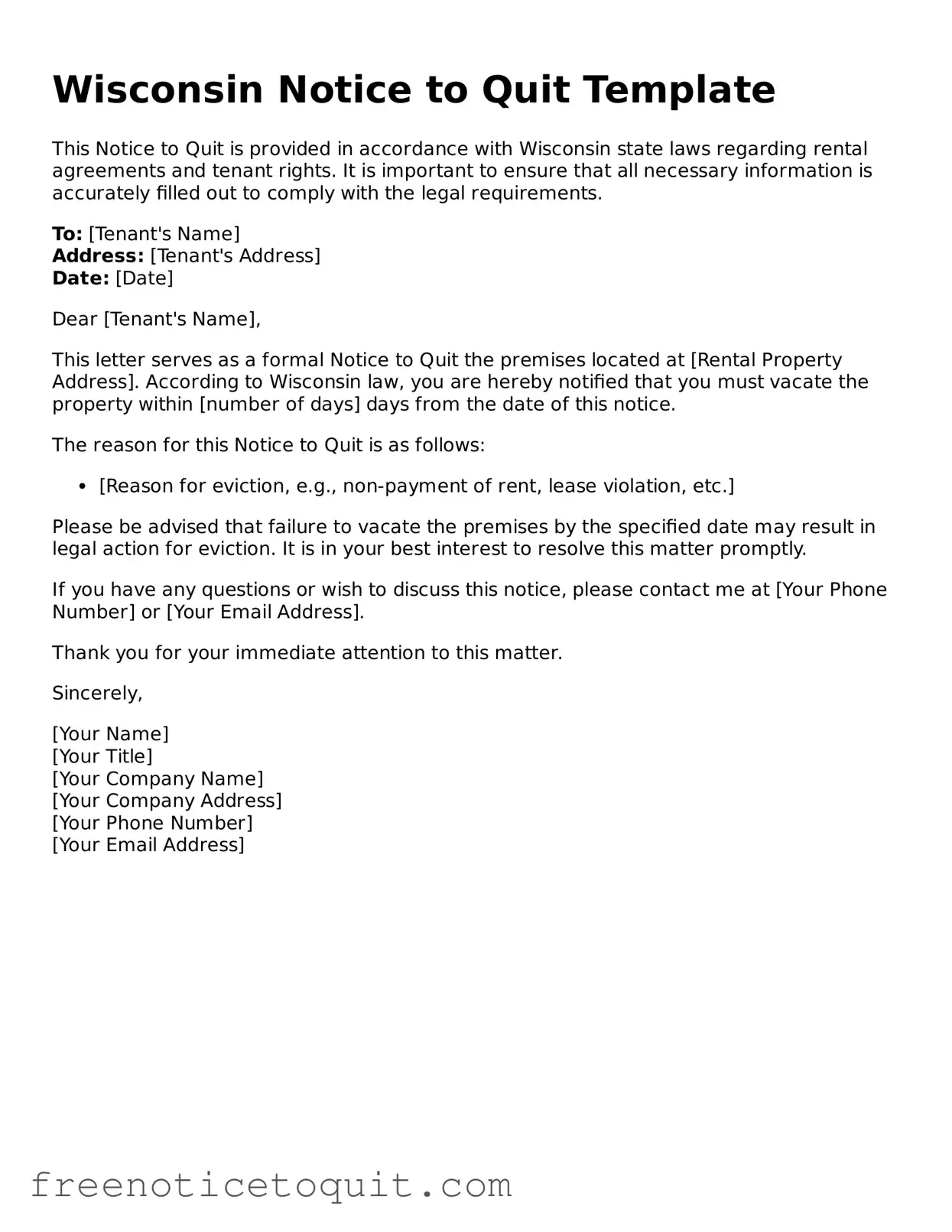
Wisconsin Notice to Quit Template

This Notice to Quit is provided in accordance with Wisconsin state laws regarding rental agreements and tenant rights. It is important to ensure that all necessary information is accurately filled out to comply with the legal requirements.

To: [Tenant's Name]
Address: [Tenant's Address]
Date: [Date]

Dear [Tenant's Name],

This letter serves as a formal Notice to Quit the premises located at [Rental Property Address]. According to Wisconsin law, you are hereby notified that you must vacate the property within [number of days] days from the date of this notice.

The reason for this Notice to Quit is as follows:

  • [Reason for eviction, e.g., non-payment of rent, lease violation, etc.]

Please be advised that failure to vacate the premises by the specified date may result in legal action for eviction. It is in your best interest to resolve this matter promptly.

If you have any questions or wish to discuss this notice, please contact me at [Your Phone Number] or [Your Email Address].

Thank you for your immediate attention to this matter.

Sincerely,

[Your Name]
[Your Title]
[Your Company Name]
[Your Company Address]
[Your Phone Number]
[Your Email Address]

PDF Data

Fact Name Description
Governing Law The Wisconsin Notice to Quit form is governed by Wisconsin Statutes Chapter 704, which outlines the rights and responsibilities of landlords and tenants.
Purpose This form is used by landlords to formally notify tenants of the termination of a rental agreement, typically due to lease violations or non-payment of rent.
Notice Period The required notice period can vary; for non-payment of rent, landlords must provide a 5-day notice, while for other lease violations, a 14-day notice is standard.
Delivery Methods The Notice to Quit can be delivered in person, by certified mail, or by posting it on the tenant's door if they cannot be reached.
Tenant Rights Tenants have the right to contest the notice in court, allowing them to present their case if they believe the eviction is unjustified.
Form Requirements The form must include specific information such as the tenant's name, address, and the reason for termination to be considered valid.
Signature Requirement The landlord or their authorized agent must sign the Notice to Quit for it to be legally binding.
Effectiveness Once delivered, the notice serves as a prerequisite to initiating formal eviction proceedings in court.
Local Variations While the state provides a general framework, local ordinances may impose additional requirements or protections for tenants.

Instructions on Utilizing Wisconsin Notice to Quit

Once you have the Wisconsin Notice to Quit form ready, it's important to fill it out carefully. This form is used to notify a tenant to vacate the property. After completing the form, you will need to serve it to the tenant according to state guidelines.

  1. Begin by entering the date at the top of the form.
  2. Fill in your name and address in the designated sections. This is your information as the landlord.
  3. Next, provide the tenant's name and address. Make sure this information is accurate.
  4. Specify the reason for the notice. Be clear and concise about why you are asking the tenant to leave.
  5. Indicate the date by which the tenant must vacate the property. This should comply with the required notice period.
  6. Sign the form at the bottom. Your signature confirms that you are the landlord issuing the notice.
  7. Make a copy of the completed form for your records.

After filling out the form, you will need to deliver it to the tenant. Ensure you follow the proper method of service, as required by Wisconsin law. This step is crucial for the notice to be valid.

FAQ

What is a Wisconsin Notice to Quit form?

The Wisconsin Notice to Quit form is a legal document used by landlords to inform tenants that they must vacate the rental property. This notice typically outlines the reasons for the eviction and provides a timeline for the tenant to leave the premises. It is an essential step in the eviction process, ensuring that tenants are formally notified of their landlord's intentions.

When is a Notice to Quit necessary?

A Notice to Quit is necessary when a landlord wishes to terminate a rental agreement due to various reasons, such as non-payment of rent, lease violations, or the end of a lease term. In Wisconsin, landlords must provide this notice to tenants before proceeding with formal eviction proceedings in court.

How much notice must be given in a Notice to Quit?

The amount of notice required varies depending on the reason for the eviction. For example, if a tenant has not paid rent, a landlord must provide a 5-day notice to quit. For lease violations, a 14-day notice is typically required. If the lease has expired, a 28-day notice may be necessary. It's important for landlords to adhere to these timelines to ensure compliance with state laws.

Can a tenant contest a Notice to Quit?

Yes, tenants have the right to contest a Notice to Quit. If a tenant believes the notice is unjust or incorrect, they can respond to the landlord, seeking clarification or resolution. If the matter escalates, tenants can present their case in court during eviction proceedings, providing evidence to support their position.

What happens if a tenant does not comply with a Notice to Quit?

If a tenant does not comply with the Notice to Quit by the specified deadline, the landlord may proceed with filing an eviction action in court. This process can lead to a court hearing, where both parties can present their arguments. If the court rules in favor of the landlord, a judgment for eviction may be issued, allowing the landlord to regain possession of the property.

Is a Notice to Quit the same as an eviction notice?

While a Notice to Quit and an eviction notice are related, they are not the same. A Notice to Quit is the initial step that informs the tenant of the landlord's intent to terminate the rental agreement. An eviction notice typically follows if the tenant fails to vacate the property within the specified time frame outlined in the Notice to Quit.

Where can I obtain a Wisconsin Notice to Quit form?

A Wisconsin Notice to Quit form can be obtained from various sources, including online legal resources, local government websites, or through legal aid organizations. It is crucial to ensure that the form complies with Wisconsin state laws and includes all necessary information to be considered valid.
Common mistakes

  1. Inaccurate Information: Providing incorrect names, addresses, or other essential details can render the notice ineffective.

  2. Failure to Specify the Reason: Not clearly stating the reason for the notice can lead to confusion and potential legal challenges.

  3. Missing Signatures: Forgetting to sign the form is a common oversight that can invalidate the notice.

  4. Incorrect Dates: Using the wrong date for when the notice is served or when the tenant is expected to vacate can create complications.

  5. Not Following Local Laws: Ignoring specific local regulations or requirements can undermine the notice’s effectiveness.

  6. Improper Delivery Method: Failing to deliver the notice in a legally acceptable manner can lead to disputes over whether the tenant received it.

  7. Omitting Required Information: Neglecting to include all necessary details, such as the lease agreement date or the amount owed, can weaken the notice.

  8. Inconsistent Language: Using vague or inconsistent language may lead to misinterpretations of the notice’s intent.

  9. Not Keeping Copies: Failing to retain a copy of the notice for personal records can complicate future legal proceedings.

  10. Ignoring Tenant Rights: Overlooking the rights of the tenant can result in legal repercussions and an invalid notice.

Documents used along the form

When dealing with tenancy issues in Wisconsin, several forms and documents may accompany the Notice to Quit form. Each of these documents serves a specific purpose in the rental process, helping both landlords and tenants understand their rights and responsibilities.

  • Lease Agreement: This is the foundational document that outlines the terms and conditions of the rental arrangement. It specifies the duration of the lease, rental amount, and rules governing the property.
  • Eviction Notice: If a tenant fails to comply with the terms of the lease, an eviction notice may be issued. This document formally notifies the tenant of the landlord's intention to terminate the lease and outlines the reasons for eviction.
  • Rent Payment Receipts: These receipts serve as proof of rent payments made by the tenant. They can be crucial in disputes regarding payment history or claims of non-payment.
  • Tenant's Response Form: This form allows tenants to respond to an eviction notice or other legal documents. It provides an opportunity for tenants to present their side of the situation.
  • Notice of Rent Increase: If a landlord decides to raise the rent, this notice informs the tenant of the new rental amount and the date it will take effect. It ensures that tenants are aware of changes to their financial obligations.

Understanding these documents can help both landlords and tenants navigate their rights and responsibilities effectively. Being informed is key to maintaining a healthy rental relationship.

Similar forms

The Wisconsin Notice to Quit form is similar to the Eviction Notice, which is used in many states. An Eviction Notice informs a tenant that they must vacate the rental property. Like the Notice to Quit, it typically specifies the reason for eviction and the time frame in which the tenant must leave. Both documents serve as formal communication from the landlord to the tenant regarding the termination of the rental agreement.

Another similar document is the Lease Termination Letter. This letter is used by landlords or tenants to end a lease agreement. It provides a clear indication of the intent to terminate the lease, similar to how a Notice to Quit functions. Both documents must adhere to specific time frames, ensuring that all parties are aware of their rights and responsibilities regarding the lease.

The 30-Day Notice to Vacate is another related document. This notice is commonly used to inform tenants that they must move out within 30 days. It shares similarities with the Notice to Quit in that it outlines the timeline for moving out and the reasons for the request. Both documents aim to provide clear communication between landlords and tenants.

The Three-Day Notice to Pay Rent or Quit is also comparable. This notice is issued when a tenant fails to pay rent on time. It demands that the tenant either pay the overdue rent or vacate the property within three days. Like the Notice to Quit, it serves as a formal warning and outlines the consequences of non-compliance.

The Notice of Non-Renewal is another similar document. This notice is sent by landlords to inform tenants that their lease will not be renewed at the end of the term. It provides a clear timeline for the tenant to vacate the property, similar to a Notice to Quit. Both documents are essential for ensuring a smooth transition for both parties.

The Pay or Quit Notice is akin to the Three-Day Notice to Pay Rent or Quit. It requires tenants to either pay their rent or leave the property. This document emphasizes the urgency of the situation, similar to the Notice to Quit, and outlines the specific actions the tenant must take within a given timeframe.

The Conditional Quit Notice is another related document. This notice is issued when a tenant violates a specific term of the lease, such as having unauthorized pets. It informs the tenant that they must correct the violation or vacate the property. Both the Conditional Quit Notice and the Notice to Quit serve to communicate serious issues regarding the rental agreement.

The Notice to Cure is similar as well. This document is sent to a tenant when they breach a lease agreement but can rectify the situation, such as by repairing damages. Like the Notice to Quit, it outlines the necessary steps the tenant must take to remain in the property. Both documents focus on compliance with the lease terms.

The Notice of Intent to Vacate is another document that shares similarities. This notice is typically provided by tenants to inform landlords of their intention to move out. It outlines the timeline for leaving the property and ensures that both parties are aware of the upcoming vacancy, similar to how a Notice to Quit functions.

Lastly, the Rent Demand Letter is comparable to the Notice to Quit. This letter requests payment of overdue rent and informs the tenant of the consequences of non-payment. Both documents serve as formal reminders and communicate important information regarding the tenant's obligations under the lease agreement.

Dos and Don'ts

When filling out the Wisconsin Notice to Quit form, it's important to follow certain guidelines to ensure the process goes smoothly. Here’s a list of things you should and shouldn't do:

  • Do provide accurate information about the tenant and the property.
  • Do specify the reason for the notice clearly.
  • Do include the date the notice is being issued.
  • Do keep a copy of the completed notice for your records.
  • Don't use vague language or general statements.
  • Don't forget to sign and date the form.
  • Don't deliver the notice in a way that is not legally compliant.
  • Don't ignore local laws or specific requirements for your area.

Following these guidelines will help ensure that the Notice to Quit is properly filled out and legally valid.

Misconceptions

When it comes to the Wisconsin Notice to Quit form, there are several misconceptions that can lead to confusion for both landlords and tenants. Understanding the truth behind these misconceptions is crucial for navigating the rental process effectively. Here’s a look at some common misunderstandings:

  • Misconception 1: The Notice to Quit is the same as an eviction notice.
  • This is not true. A Notice to Quit is a preliminary step that informs a tenant to vacate the premises. An eviction notice follows if the tenant does not comply.

  • Misconception 2: A landlord can give a Notice to Quit for any reason.
  • Landlords must have a valid reason, such as non-payment of rent or lease violations, to issue a Notice to Quit. Simply wanting the tenant to leave is not sufficient.

  • Misconception 3: Tenants have no rights after receiving a Notice to Quit.
  • Tenants still have rights. They can contest the notice, seek legal advice, or negotiate with the landlord.

  • Misconception 4: A Notice to Quit must be delivered in person.
  • While personal delivery is one option, landlords can also send the notice via certified mail, ensuring there is proof of delivery.

  • Misconception 5: The Notice to Quit gives an immediate eviction date.
  • The notice specifies a time frame, usually several days, during which the tenant must vacate. Immediate eviction does not occur.

  • Misconception 6: A Notice to Quit is only for non-payment of rent.
  • It can also be issued for lease violations, illegal activities, or other breaches of the rental agreement.

  • Misconception 7: Once a Notice to Quit is issued, the landlord cannot change their mind.
  • Landlords can withdraw a Notice to Quit if they reach an agreement with the tenant before the specified deadline.

Understanding these misconceptions can help both landlords and tenants navigate their rights and responsibilities more effectively. Always consider seeking legal advice for specific situations.

Key takeaways

When dealing with the Wisconsin Notice to Quit form, it is essential to understand its purpose and how to use it effectively. Here are some key takeaways that can help you navigate this process:

  • Purpose of the Notice: The Notice to Quit serves as a formal request for a tenant to vacate the rental property. It is typically issued when a landlord seeks to terminate a lease agreement for reasons such as non-payment of rent or lease violations.
  • Required Information: The form must include specific details, such as the tenant's name, the address of the rental property, and the reason for the eviction. Providing accurate information is crucial for the validity of the notice.
  • Delivery Methods: The Notice to Quit can be delivered in several ways, including personal delivery, mail, or posting on the property. Each method has its own requirements, so it is important to choose one that complies with Wisconsin law.
  • Timeframes: Different reasons for eviction may require different notice periods. For instance, a 5-day notice is typically required for non-payment of rent, while a 14-day notice may be necessary for lease violations. Understanding these timeframes is vital for ensuring compliance.
  • Tenant Rights: Tenants have rights that must be respected during the eviction process. They may respond to the notice, and landlords cannot forcibly remove tenants without a court order. Familiarity with these rights can help both parties navigate the situation more effectively.
  • Legal Consequences: Failing to properly complete or deliver the Notice to Quit can result in delays or complications in the eviction process. It is advisable to ensure that all legal requirements are met to avoid potential issues in court.

By keeping these points in mind, individuals can better understand the implications of the Wisconsin Notice to Quit form and take appropriate steps in the eviction process.

Printable Notice to Quit Template for the State of Wisconsin

Open Notice to Quit Editor Here