Official Notice of Lease Non-Renewal Form Open Notice of Lease Non-Renewal Editor Here

Official Notice of Lease Non-Renewal Form

The Notice of Lease Non-Renewal form is a crucial document used by landlords to inform tenants that their lease will not be extended beyond its current term. This form serves as an official communication, ensuring that both parties are aware of the lease's expiration and the need to vacate the premises. Understanding this form can help tenants and landlords navigate the end of a lease smoothly and avoid potential misunderstandings.

The Notice of Lease Non-Renewal form serves as a critical communication tool between landlords and tenants when a lease agreement is nearing its end. This document outlines the intention not to extend or renew the existing lease, providing clarity and transparency for both parties. Typically, the form includes essential details such as the names of the landlord and tenant, the property address, and the specific date the lease will terminate. Additionally, it often specifies the required notice period, which varies by state and lease agreement. By issuing this notice, landlords fulfill their legal obligation while allowing tenants to prepare for their next steps, whether that involves seeking a new rental or making arrangements to vacate the property. Understanding the implications of this form is vital for both landlords and tenants to ensure a smooth transition at the end of the lease term.

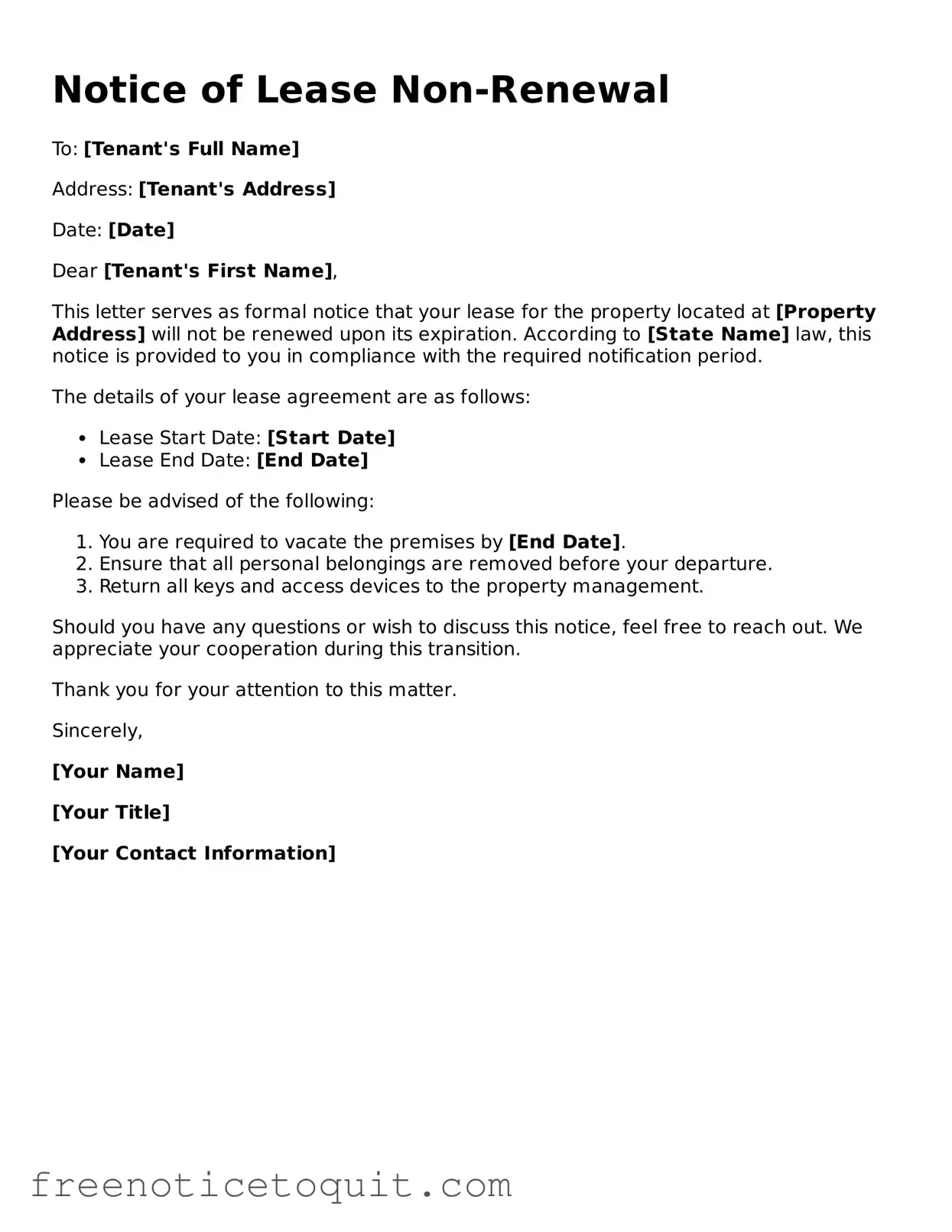
Notice of Lease Non-Renewal Sample

Notice of Lease Non-Renewal

To: [Tenant's Full Name]

Address: [Tenant's Address]

Date: [Date]

Dear [Tenant's First Name],

This letter serves as formal notice that your lease for the property located at [Property Address] will not be renewed upon its expiration. According to [State Name] law, this notice is provided to you in compliance with the required notification period.

The details of your lease agreement are as follows:

  • Lease Start Date: [Start Date]
  • Lease End Date: [End Date]

Please be advised of the following:

  1. You are required to vacate the premises by [End Date].
  2. Ensure that all personal belongings are removed before your departure.
  3. Return all keys and access devices to the property management.

Should you have any questions or wish to discuss this notice, feel free to reach out. We appreciate your cooperation during this transition.

Thank you for your attention to this matter.

Sincerely,

[Your Name]

[Your Title]

[Your Contact Information]

PDF Data

Fact Name Details
Purpose The Notice of Lease Non-Renewal form is used to inform a tenant that their lease will not be renewed at the end of the current term.
Notice Period Typically, landlords must provide a notice period of 30 to 60 days before the lease expiration, depending on state laws.
State Variations Each state has its own specific requirements for the form, including the notice period and delivery method.
Governing Laws In California, for example, the governing law is the California Civil Code Section 1946.
Delivery Methods The notice can often be delivered in person, by mail, or via electronic means, depending on state regulations.
Tenant Rights Tenants have the right to contest the non-renewal if they believe it violates local laws or their lease agreement.
Documentation It is advisable for landlords to keep a copy of the notice for their records and document the delivery method.

Instructions on Utilizing Notice of Lease Non-Renewal

After you complete the Notice of Lease Non-Renewal form, you will need to deliver it to your landlord or property management. Make sure to keep a copy for your records. This ensures that both parties are aware of the lease's non-renewal status.

  1. Begin by entering the date at the top of the form. This should be the date you are filling it out.
  2. Next, write your name and address in the designated fields. Ensure that this information is accurate and up-to-date.
  3. Provide the landlord's or property management's name and address. Double-check for any spelling errors.
  4. In the section for the lease details, include the start date and end date of your current lease.
  5. Clearly state your intention not to renew the lease. You may write a brief sentence to express this.
  6. Sign the form at the bottom. Your signature confirms your intent and acknowledges the notice.
  7. Finally, make a copy of the completed form for your records before submitting it to your landlord or property management.

FAQ

What is a Notice of Lease Non-Renewal form?

The Notice of Lease Non-Renewal form is a document used by landlords or property owners to inform tenants that their lease will not be renewed once it expires. This notice provides clarity and allows both parties to prepare for the end of the lease term.

Who should use the Notice of Lease Non-Renewal form?

This form is primarily used by landlords or property managers. If you are a tenant receiving such a notice, it is important to understand your rights and responsibilities as you approach the end of your lease.

How much notice do I need to give my tenant?

The required notice period can vary based on local laws and the terms of the lease. Typically, landlords must provide notice at least 30 days before the lease expiration date. Always check your state’s regulations to ensure compliance.

What information should be included in the Notice of Lease Non-Renewal?

Essential details include the tenant's name, the property address, the lease expiration date, and a clear statement indicating that the lease will not be renewed. It’s also helpful to include the date the notice is being issued.

Can a tenant contest a Notice of Lease Non-Renewal?

Yes, tenants may contest a Notice of Lease Non-Renewal if they believe it violates their rights. For example, if they suspect retaliation or discrimination, they should seek legal advice to understand their options.

What happens if a tenant stays after the lease expires?

If a tenant remains in the property after the lease has expired without a renewal agreement, they may be considered a holdover tenant. This can lead to legal complications, including eviction proceedings, so it’s best to communicate with the landlord about intentions to stay or vacate.

Is there a specific format for the Notice of Lease Non-Renewal?

While there is no universally mandated format, it’s important that the notice is clear and includes all required information. Using a template can help ensure you don’t miss any key details.

Can a landlord refuse to renew a lease for any reason?

Generally, landlords can choose not to renew a lease for various reasons, provided they do not violate anti-discrimination laws or retaliate against tenants for exercising their rights. It’s wise to document the reasons for non-renewal.

What should a tenant do upon receiving a Notice of Lease Non-Renewal?

Upon receiving this notice, a tenant should review the lease terms, understand their rights, and start planning for their next steps, whether that means finding a new place to live or discussing the situation with the landlord.

Can a tenant request an extension after receiving a Notice of Lease Non-Renewal?

Yes, a tenant can request an extension or renewal of their lease. It’s important to communicate this request to the landlord as soon as possible. However, the landlord is not obligated to agree to the extension.
Common mistakes

  1. Failing to provide accurate tenant information. It's crucial to include the correct names and addresses of all tenants involved in the lease.

  2. Not specifying the correct lease end date. Make sure to clearly state the date when the lease will officially end to avoid confusion.

  3. Omitting the reason for non-renewal. While not always necessary, providing a reason can help clarify the situation and prevent misunderstandings.

  4. Not signing the form. A signature is essential; without it, the notice may not be considered valid.

  5. Failing to send the notice in a timely manner. Many leases require that the notice be given a specific number of days before the lease ends.

  6. Using incorrect delivery methods. Ensure that the notice is delivered according to the lease agreement, whether by mail, email, or in person.

  7. Not keeping a copy for personal records. Always retain a copy of the notice for your own documentation and future reference.

  8. Ignoring local laws and regulations. Each state may have different rules regarding lease non-renewal notices, so it’s important to be aware of these.

  9. Assuming verbal communication is sufficient. Relying solely on a conversation without a written notice can lead to disputes.

Documents used along the form

The Notice of Lease Non-Renewal form is an important document in the lease termination process. It is often accompanied by other forms and documents that help clarify the terms and conditions of the lease agreement. Below is a list of commonly used forms that may accompany the Notice of Lease Non-Renewal.

  • Lease Agreement: This document outlines the terms of the rental arrangement between the landlord and tenant, including duration, rent amount, and responsibilities of both parties.
  • Move-Out Checklist: A checklist that details the tasks the tenant must complete before vacating the property, ensuring the return of the security deposit.
  • Security Deposit Return Form: A form used by the landlord to document the return of the security deposit, including any deductions for damages or unpaid rent.
  • Final Inspection Report: A report prepared by the landlord or property manager that assesses the condition of the property at the end of the lease term.
  • Written Notice of Intent to Vacate: A formal notice from the tenant to the landlord indicating their intention to leave the property, often required by lease terms.
  • Utilities Transfer Form: A form that facilitates the transfer of utility services from the tenant to the landlord or new tenant upon move-out.
  • Lease Extension Agreement: If applicable, this document allows both parties to agree on extending the lease term under specified conditions.
  • Rental Application: A form completed by prospective tenants that provides background information, which may be relevant if the property is being re-rented.

These documents collectively ensure a smooth transition for both landlords and tenants during the lease termination process. Proper documentation helps protect the rights of both parties and clarifies expectations moving forward.

Similar forms

The Notice of Lease Termination is a document that serves a similar purpose to the Notice of Lease Non-Renewal form. Both documents inform tenants of the end of a lease agreement. However, the Notice of Lease Termination explicitly states that the lease is being terminated before the original end date, often due to specific reasons such as a breach of contract or failure to comply with lease terms. In contrast, the Notice of Lease Non-Renewal indicates that the lease will simply not be extended once it reaches its natural conclusion.

The Eviction Notice, also known as a Notice to Quit, shares similarities with the Notice of Lease Non-Renewal form in that it communicates a change in the tenant's status. Both documents require the landlord to notify the tenant of an impending change. However, the Eviction Notice typically involves legal proceedings and outlines the tenant's obligation to vacate the premises due to violations or non-payment, while the Notice of Lease Non-Renewal does not imply any wrongdoing on the tenant's part.

The Lease Renewal Agreement is another document that relates to the Notice of Lease Non-Renewal. While the latter indicates that a lease will not be renewed, the Lease Renewal Agreement is a proactive document that outlines the terms for extending an existing lease. Both documents are crucial in the lease lifecycle, but they represent opposite outcomes regarding the continuation of the rental relationship.

The Rent Increase Notice is similar in that it also serves as a formal communication from the landlord to the tenant regarding changes in the rental terms. While the Notice of Lease Non-Renewal focuses on the conclusion of the lease, the Rent Increase Notice informs tenants about a change in financial obligations. Both documents require a specific notice period, ensuring tenants have time to prepare for the changes.

Finally, the Move-Out Notice can be compared to the Notice of Lease Non-Renewal form. Both documents signal an end to the tenant's occupancy. The Move-Out Notice is typically issued by the tenant to inform the landlord of their intent to vacate the premises, while the Notice of Lease Non-Renewal is issued by the landlord to inform the tenant that their lease will not continue. Each document plays a crucial role in the communication between landlords and tenants regarding the status of the lease agreement.

Dos and Don'ts

When filling out the Notice of Lease Non-Renewal form, it is important to approach the process with care. Here are ten things you should and shouldn't do to ensure your form is completed correctly.

  • Do read the entire form carefully before filling it out.
  • Do provide accurate information regarding the lease and tenant details.
  • Do check the deadlines for submitting the notice to ensure compliance.
  • Do keep a copy of the completed form for your records.
  • Do sign and date the form before submission.
  • Don't leave any required fields blank; this may delay the process.
  • Don't use vague language; be clear and specific in your statements.
  • Don't submit the form without confirming it is filled out correctly.
  • Don't ignore local laws regarding notice periods; they may vary by jurisdiction.
  • Don't forget to notify the tenant in a manner consistent with your lease agreement.

Misconceptions

Here are eight common misconceptions about the Notice of Lease Non-Renewal form:

  1. It's the same as a lease termination notice.

    This form specifically indicates that the lease will not be renewed at the end of its term, rather than terminating it before the end date.

  2. Only landlords can issue this notice.

    Tenants can also use this form to inform landlords that they do not wish to renew the lease.

  3. It must be delivered in person.

    While personal delivery is an option, mailing or emailing the notice is often acceptable, depending on the lease agreement.

  4. There's no specific timeline for giving notice.

    Most leases require notice to be given within a certain timeframe, usually 30 to 60 days before the lease ends.

  5. Using this form means I have to move out immediately.

    The form simply states that the lease won't be renewed; tenants can stay until the lease expiration date.

  6. It's not necessary if I plan to move out.

    Even if you plan to move, it's a good idea to formally notify your landlord to avoid any misunderstandings.

  7. This notice can be ignored.

    Ignoring the notice can lead to complications, including potential legal issues or misunderstandings about lease terms.

  8. It can be sent at any time.

    Sending the notice too late may result in automatic renewal of the lease, depending on the lease terms.

Key takeaways

When filling out and using the Notice of Lease Non-Renewal form, consider the following key takeaways:

  1. Ensure you provide accurate information about the lease, including the property address and tenant details.
  2. Check the lease agreement for specific requirements regarding notice periods for non-renewal.
  3. Deliver the notice in a timely manner to comply with local laws and lease terms.
  4. Use clear and concise language to avoid any misunderstandings.
  5. Keep a copy of the completed notice for your records.
  6. Consider sending the notice via certified mail to provide proof of delivery.
  7. Be aware of any local regulations that may affect the non-renewal process.
  8. Consult with a legal professional if unsure about any part of the process.
  9. Inform the tenant of any next steps they may need to take after receiving the notice.
  10. Maintain professionalism throughout the process to ensure a smooth transition for both parties.

Official Notice of Lease Non-Renewal Form

Open Notice of Lease Non-Renewal Editor Here