Printable Notice to Quit Template for the State of South Carolina Open Notice to Quit Editor Here

Printable Notice to Quit Template for the State of South Carolina

The South Carolina Notice to Quit form is a legal document used by landlords to formally notify tenants that they must vacate the rental property. This notice typically serves as the first step in the eviction process, outlining the reasons for the request to leave. Understanding this form is crucial for both landlords and tenants to ensure their rights are protected during a potential eviction situation.

In South Carolina, landlords and tenants alike must navigate the complexities of rental agreements and property management. One essential document in this process is the Notice to Quit form, which serves as a formal communication tool when a landlord seeks to terminate a tenancy. This form outlines the reasons for eviction, whether due to non-payment of rent, lease violations, or other grounds permitted by law. It provides tenants with crucial information about their rights and responsibilities, including the timeframe in which they must vacate the premises. Properly completing and serving this form is vital, as it ensures compliance with state regulations and protects the interests of both parties involved. Understanding the nuances of the Notice to Quit can help prevent misunderstandings and facilitate smoother transitions in rental situations.

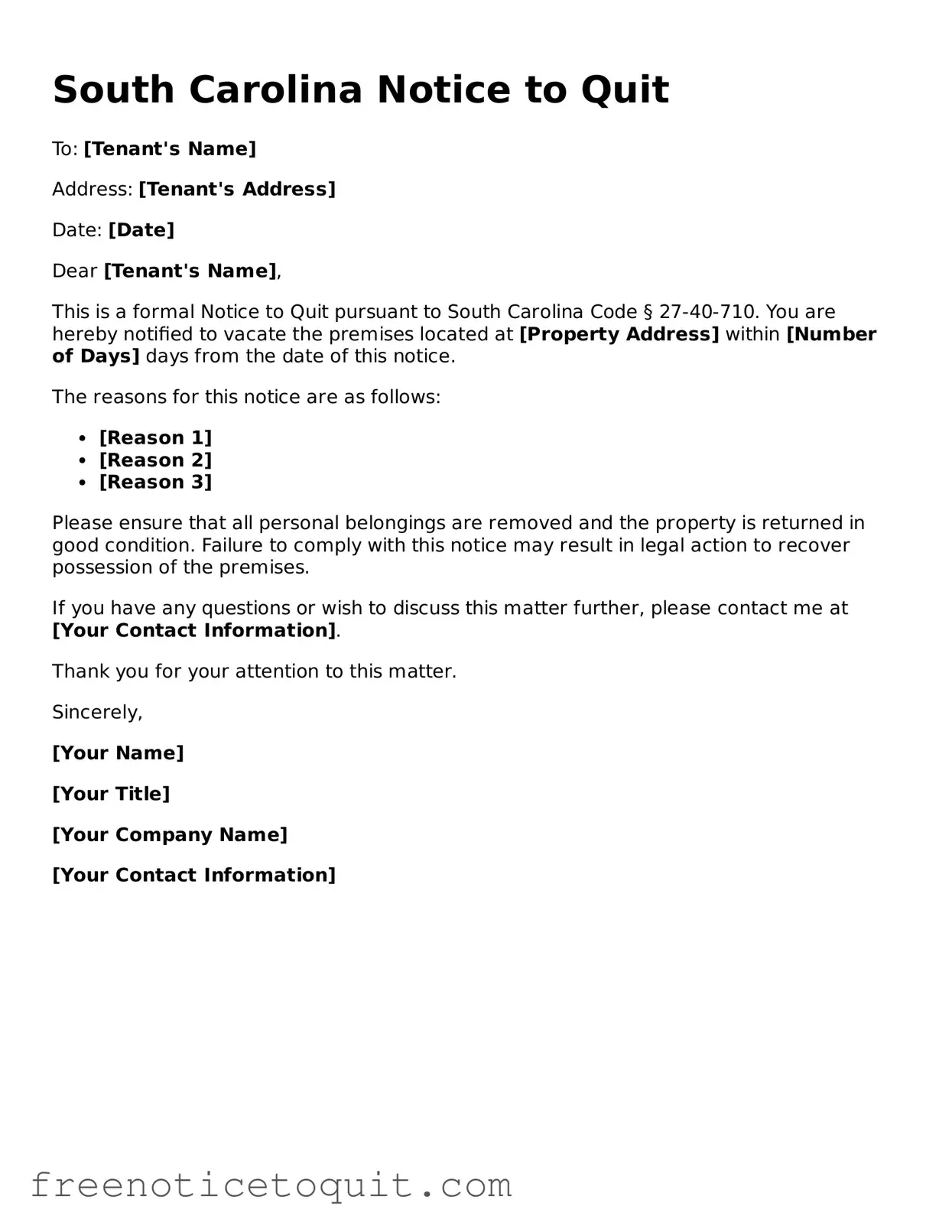
South Carolina Notice to Quit Sample

South Carolina Notice to Quit

To: [Tenant's Name]

Address: [Tenant's Address]

Date: [Date]

Dear [Tenant's Name],

This is a formal Notice to Quit pursuant to South Carolina Code § 27-40-710. You are hereby notified to vacate the premises located at [Property Address] within [Number of Days] days from the date of this notice.

The reasons for this notice are as follows:

  • [Reason 1]
  • [Reason 2]
  • [Reason 3]

Please ensure that all personal belongings are removed and the property is returned in good condition. Failure to comply with this notice may result in legal action to recover possession of the premises.

If you have any questions or wish to discuss this matter further, please contact me at [Your Contact Information].

Thank you for your attention to this matter.

Sincerely,

[Your Name]

[Your Title]

[Your Company Name]

[Your Contact Information]

PDF Data

Fact Name Description
Purpose The South Carolina Notice to Quit form is used by landlords to inform tenants of their intention to terminate a lease agreement.
Governing Law This form is governed by South Carolina Code of Laws, Title 27, Chapter 40, also known as the South Carolina Residential Landlord and Tenant Act.
Notice Period In most cases, landlords must provide at least a 14-day notice to tenants before initiating eviction proceedings.
Delivery Methods The notice can be delivered in person, by mail, or by posting it on the tenant's door.
Contents Required The form must include the date, the address of the rental property, and the reason for the termination.
Tenant's Rights Tenants have the right to contest the eviction in court if they believe the notice is unjustified.
Failure to Comply If the tenant does not vacate the property after the notice period, the landlord may proceed with filing for eviction.
Legal Assistance Both landlords and tenants are encouraged to seek legal advice when dealing with eviction processes to ensure their rights are protected.

Instructions on Utilizing South Carolina Notice to Quit

After you have gathered the necessary information, you will proceed to fill out the South Carolina Notice to Quit form. This form is essential for initiating the eviction process. Ensure that all details are accurate to avoid any delays.

  1. Begin by entering the date at the top of the form.
  2. Fill in the name of the tenant who is being served with the notice.
  3. Provide the address of the rental property, including the city and zip code.
  4. Clearly state the reason for the notice. Be specific and factual.
  5. Indicate the number of days the tenant has to vacate the property. This is typically a minimum of 14 days in South Carolina.
  6. Sign the form. Include your name and contact information as the landlord or property owner.
  7. Make a copy of the completed form for your records.
  8. Deliver the notice to the tenant. You can do this in person or send it via certified mail.

FAQ

What is a South Carolina Notice to Quit form?

The South Carolina Notice to Quit form is a legal document used by landlords to formally notify tenants that they must vacate the rental property. This notice is typically issued when a tenant has violated the lease agreement or failed to pay rent. It serves as a preliminary step before any formal eviction proceedings can be initiated.

When should a landlord use a Notice to Quit?

A landlord should use a Notice to Quit when a tenant has breached the lease terms, such as failing to pay rent, causing damage to the property, or engaging in illegal activities. The notice provides the tenant with a specified period to remedy the situation or vacate the premises, depending on the nature of the violation.

How long does a tenant have to respond to a Notice to Quit?

The time frame for a tenant to respond to a Notice to Quit varies based on the reason for the notice. For non-payment of rent, the tenant typically has five days to pay the overdue rent or vacate. For other lease violations, the notice period may be longer, often ranging from 14 to 30 days, depending on the specific circumstances outlined in the lease agreement.

Is a Notice to Quit required before filing for eviction?

Yes, in South Carolina, a Notice to Quit is generally required before a landlord can file for eviction. This notice serves to inform the tenant of the landlord's intention to terminate the lease and provides the tenant with an opportunity to address the issue. Failure to provide this notice may result in delays in the eviction process.

What information should be included in a Notice to Quit?

A Notice to Quit should include essential information such as the tenant's name, the address of the rental property, the reason for the notice, and the date by which the tenant must vacate. Additionally, it is advisable to include a statement regarding the lease violation and any actions the tenant can take to remedy the situation.

Can a tenant contest a Notice to Quit?

Yes, a tenant has the right to contest a Notice to Quit. If the tenant believes the notice is unjustified, they can respond in writing or seek legal advice. If the matter escalates to eviction proceedings, the tenant can present their case in court, where both parties will have the opportunity to provide evidence and argue their positions.

Where can I obtain a South Carolina Notice to Quit form?

A South Carolina Notice to Quit form can be obtained from various sources. Landlords may find templates available online through legal aid websites or local government resources. It is important to ensure that the form complies with South Carolina state laws and includes all necessary information specific to the situation.
Common mistakes

  1. Inaccurate Tenant Information: One common mistake is providing incorrect or incomplete information about the tenant. This includes missing names, wrong addresses, or incorrect lease details. Such errors can lead to delays or complications in the eviction process.

  2. Failure to Specify the Reason for Termination: The Notice to Quit must clearly state the reason for termination. Whether it’s non-payment of rent or lease violations, failing to specify this can render the notice ineffective.

  3. Incorrect Notice Period: South Carolina law requires specific notice periods depending on the reason for termination. Mistakes in calculating the appropriate notice period can lead to legal challenges. Always double-check the required time frame.

  4. Not Signing the Notice: A signature is essential for the notice to be valid. Some individuals forget to sign the document, which can invalidate the entire process. Ensure that the notice is signed and dated before delivery.

  5. Improper Delivery Method: The law outlines acceptable methods for delivering the Notice to Quit. Using an incorrect method, such as verbal communication or informal delivery, can result in the notice being deemed ineffective. Always follow the legal requirements for serving the notice.

Documents used along the form

When dealing with rental agreements and tenant evictions in South Carolina, several forms and documents may accompany the Notice to Quit. Each of these documents serves a specific purpose and can help clarify the process for both landlords and tenants. Below is a list of commonly used forms that you might encounter.

  • Lease Agreement: This is the foundational document that outlines the terms and conditions of the rental arrangement between the landlord and tenant. It includes details such as rent amount, duration of the lease, and responsibilities of each party.
  • Notice of Rent Increase: If a landlord intends to raise the rent, this notice informs the tenant of the upcoming change. It typically specifies the new rent amount and the effective date of the increase.
  • Eviction Notice: This document serves as a formal notification to the tenant that the landlord is initiating eviction proceedings. It outlines the reasons for the eviction and the timeframe in which the tenant must vacate the premises.
  • Response to Eviction Notice: Tenants may use this document to formally respond to an eviction notice. It allows them to present their case, dispute the claims made by the landlord, or request additional time to resolve the situation.
  • Rental Payment Receipt: This form provides proof of payment for rent made by the tenant. It is important for both parties to keep accurate records of all transactions related to the lease.
  • Move-Out Checklist: This document helps tenants prepare for their departure from the rental property. It outlines tasks to complete before moving out, ensuring that the property is left in good condition and the security deposit is returned.

Understanding these documents can help ensure a smoother process for both landlords and tenants. Each form plays a vital role in maintaining clear communication and legal compliance throughout the rental relationship.

Similar forms

The Eviction Notice, often used in various states, serves a similar purpose to the South Carolina Notice to Quit form. Both documents inform tenants that they must vacate the property, typically due to lease violations or non-payment of rent. The Eviction Notice outlines the reasons for the eviction and provides a timeline for the tenant to leave. Like the Notice to Quit, it is a formal communication that initiates the eviction process, ensuring that tenants are aware of their obligations and the potential consequences of not complying.

The Lease Termination Letter is another document that shares similarities with the Notice to Quit form. This letter is used by landlords to formally notify tenants that their lease will not be renewed or is being terminated. While the Notice to Quit often addresses specific violations, the Lease Termination Letter may be issued for a variety of reasons, including the end of a lease term or changes in property management. Both documents serve to communicate the landlord's intent and provide a clear timeline for the tenant's departure.

The Pay or Quit Notice is closely related to the Notice to Quit form, particularly when the reason for eviction is non-payment of rent. This notice demands that the tenant either pay the overdue rent or vacate the premises within a specified timeframe. It highlights the tenant's obligation to fulfill their financial responsibilities and serves as a warning that further legal action may follow if the situation is not resolved. Both documents emphasize the importance of timely communication regarding rental obligations.

The Cure or Quit Notice is another document that parallels the South Carolina Notice to Quit. This notice is issued when a tenant has violated a lease term but has the opportunity to correct the issue within a specified period. The Cure or Quit Notice details the violation and allows the tenant to remedy the situation before facing eviction. Similar to the Notice to Quit, it aims to provide tenants with a chance to comply with lease terms and avoid further legal action.

The 3-Day Notice to Pay Rent or Quit is specific to some jurisdictions and serves a function similar to the Notice to Quit form. This notice informs tenants that they have three days to pay overdue rent or face eviction proceedings. It is a concise and direct communication, emphasizing the urgency of the situation. Like the Notice to Quit, it is a critical step in the eviction process, ensuring that tenants understand the consequences of non-payment.

The Notice of Lease Violation is another document that shares characteristics with the South Carolina Notice to Quit. This notice is used to inform tenants of specific lease violations, such as unauthorized pets or excessive noise. It outlines the nature of the violation and may provide a timeframe for the tenant to correct the issue. Both documents aim to address problems within the rental agreement and communicate the landlord's expectations to the tenant.

The Notice of Non-Renewal is similar to the Notice to Quit in that it informs tenants that their lease will not be extended. This document may be issued for various reasons, such as changes in rental policies or the landlord's decision to sell the property. It provides tenants with information about when they need to vacate the premises, ensuring they have adequate time to make alternative living arrangements. Both notices serve as formal communications that outline the landlord's intentions.

The Demand for Possession is another document akin to the South Carolina Notice to Quit form. This demand is often issued after a tenant has failed to comply with previous notices, such as a Pay or Quit Notice. It formally requests that the tenant vacate the property, typically within a specific timeframe. Like the Notice to Quit, it signals the landlord's intent to pursue eviction if the tenant does not comply, reinforcing the importance of adhering to lease agreements.

Dos and Don'ts

When filling out the South Carolina Notice to Quit form, it's essential to approach the process carefully. Here are ten important dos and don'ts to keep in mind:

  • Do ensure that you have the correct form for your situation.
  • Don't leave any sections of the form blank; complete every required field.
  • Do clearly state the reason for the notice.
  • Don't use vague language; be specific about the issue at hand.
  • Do include the date when the notice is served.
  • Don't forget to sign and date the form before submitting it.
  • Do provide accurate contact information for both parties involved.
  • Don't use threatening or aggressive language in the notice.
  • Do keep a copy of the completed notice for your records.
  • Don't ignore local laws or regulations that may affect the notice process.

By following these guidelines, you can help ensure that your Notice to Quit is filled out correctly and effectively. Taking the time to do it right can make a significant difference in the outcome of your situation.

Misconceptions

When it comes to the South Carolina Notice to Quit form, several misconceptions can lead to confusion for both landlords and tenants. Here are five common misunderstandings:

  1. Misconception 1: The Notice to Quit is the same as an eviction notice.

    This is not true. The Notice to Quit is a preliminary step that informs a tenant they need to vacate the property. An eviction notice comes later in the process if the tenant does not comply.

  2. Misconception 2: A landlord can skip the Notice to Quit if they want to evict a tenant quickly.

    This is incorrect. South Carolina law requires landlords to provide a Notice to Quit before proceeding with eviction. Skipping this step can lead to legal complications.

  3. Misconception 3: The Notice to Quit must be delivered in person.

    While personal delivery is one option, landlords can also send the Notice to Quit via certified mail or post it on the property. Various methods are acceptable as long as they follow legal guidelines.

  4. Misconception 4: Tenants have unlimited time to respond to a Notice to Quit.

    This is misleading. Tenants usually have a specific timeframe to respond or vacate, often set by state law or the terms of their lease agreement.

  5. Misconception 5: A Notice to Quit can be issued for any reason.

    Not quite. In South Carolina, valid reasons include non-payment of rent or lease violations. Landlords must have a legitimate cause for issuing this notice.

Understanding these misconceptions can help both landlords and tenants navigate the rental process more effectively.

Key takeaways

When dealing with the South Carolina Notice to Quit form, it’s essential to understand its purpose and the correct way to fill it out. Here are some key takeaways to consider:

  • Purpose of the Notice: The Notice to Quit serves as a formal request for a tenant to vacate the rental property. It is often used in situations of non-payment of rent or lease violations.
  • Required Information: Ensure that all necessary details are included, such as the tenant's name, address of the rental property, and the reason for the notice.
  • Delivery Method: The Notice must be delivered in a manner that complies with state law. This can include personal delivery, certified mail, or posting on the property.
  • Timeframe: Be aware of the specific timeframe required for the tenant to respond to the Notice. This varies based on the reason for the eviction.
  • Legal Consequences: Failing to follow the proper procedures outlined in the Notice to Quit can lead to delays in the eviction process or potential legal issues.

Understanding these key points can help ensure that the process is handled correctly and efficiently.

Printable Notice to Quit Template for the State of South Carolina

Open Notice to Quit Editor Here