Printable Notice to Quit Template for the State of Nebraska Open Notice to Quit Editor Here

Printable Notice to Quit Template for the State of Nebraska

The Nebraska Notice to Quit form is a legal document used by landlords to formally notify tenants that they must vacate the rental property. This notice serves as a crucial step in the eviction process, outlining the reasons for termination of the tenancy. Understanding this form is essential for both landlords and tenants to ensure their rights are protected and the process is followed correctly.

The Nebraska Notice to Quit form is a crucial document in the landlord-tenant relationship, serving as a formal notification that a tenant must vacate the rental property. This form is typically used when a tenant has violated the terms of their lease agreement, such as failing to pay rent or engaging in disruptive behavior. It outlines the specific reasons for the eviction and provides the tenant with a clear timeline for vacating the premises. By adhering to the legal requirements outlined in this notice, landlords can ensure they are taking the appropriate steps to regain possession of their property. Tenants, on the other hand, should understand their rights and responsibilities upon receiving this notice. The form also includes essential information such as the address of the rental property, the date of issuance, and instructions for the tenant. Understanding the Nebraska Notice to Quit is vital for both parties involved, as it helps to clarify expectations and facilitate a smoother transition during the eviction process.

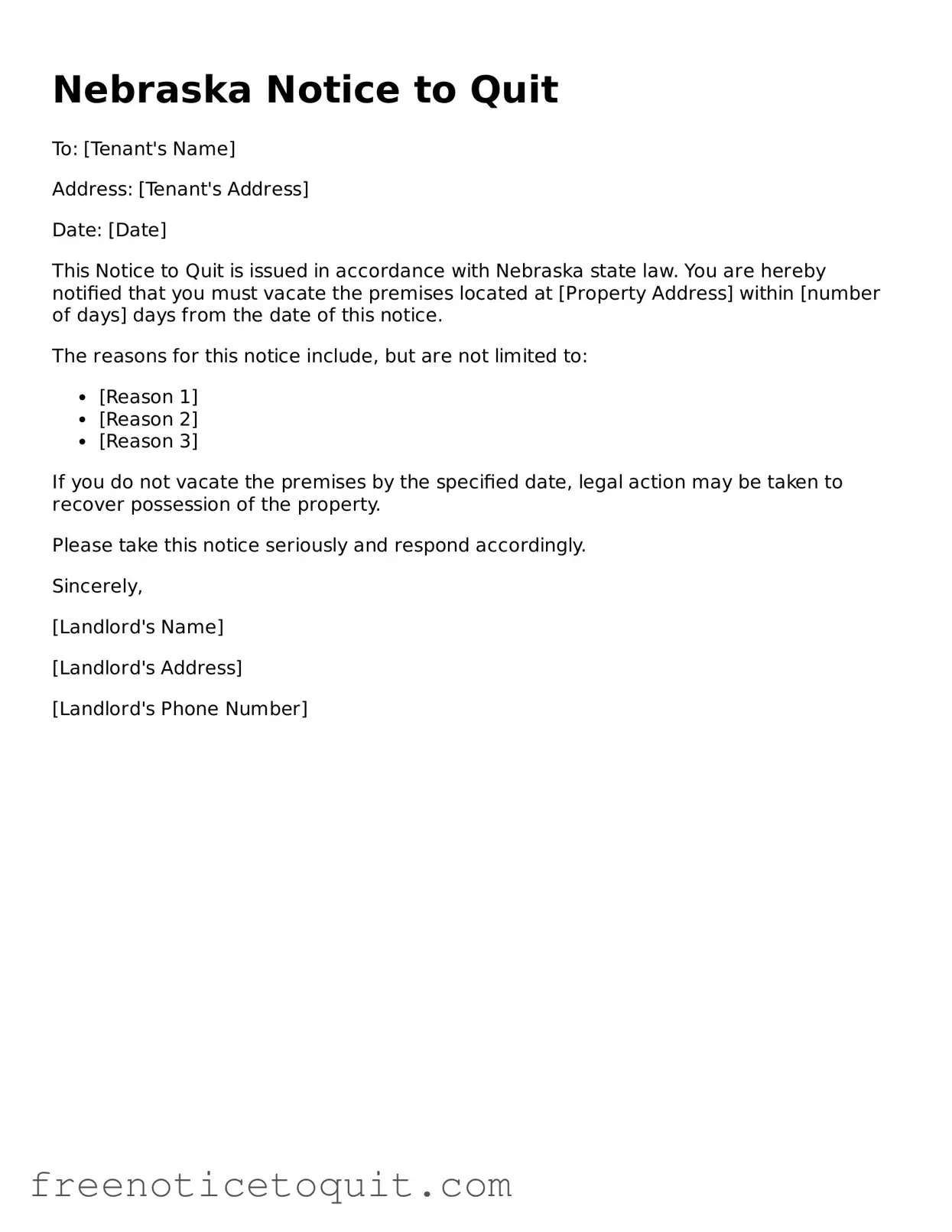
Nebraska Notice to Quit Sample

Nebraska Notice to Quit

To: [Tenant's Name]

Address: [Tenant's Address]

Date: [Date]

This Notice to Quit is issued in accordance with Nebraska state law. You are hereby notified that you must vacate the premises located at [Property Address] within [number of days] days from the date of this notice.

The reasons for this notice include, but are not limited to:

  • [Reason 1]
  • [Reason 2]
  • [Reason 3]

If you do not vacate the premises by the specified date, legal action may be taken to recover possession of the property.

Please take this notice seriously and respond accordingly.

Sincerely,

[Landlord's Name]

[Landlord's Address]

[Landlord's Phone Number]

PDF Data

Fact Name Description
Purpose The Nebraska Notice to Quit form is used by landlords to formally notify tenants to vacate the rental property.
Governing Law This form is governed by Nebraska Revised Statutes § 76-1412.
Notice Period Landlords must provide a minimum of 3 days' notice for non-payment of rent.
Delivery Methods The notice can be delivered in person, by mail, or by posting it on the property.
Tenant's Rights Tenants have the right to contest the notice in court if they believe it is unjust.
Form Requirements The form must include the date, address of the property, and the reason for the notice.
Consequences of Non-Compliance If tenants do not comply, landlords may proceed with eviction proceedings.

Instructions on Utilizing Nebraska Notice to Quit

Once you have the Nebraska Notice to Quit form ready, you'll need to fill it out accurately. This form is essential for notifying a tenant about the need to vacate the premises. After completing the form, you will need to deliver it to the tenant according to the legal requirements.

  1. Begin by entering the date at the top of the form.
  2. Fill in your name and address as the landlord or property owner.
  3. Provide the tenant's name and address where they currently reside.
  4. Clearly state the reason for the notice. Be concise and specific.
  5. Indicate the number of days the tenant has to vacate the property, as required by Nebraska law.
  6. Sign the form at the bottom to validate it.
  7. Make a copy of the completed form for your records.
  8. Deliver the notice to the tenant in person or through a method allowed by law, such as certified mail.

FAQ

What is a Nebraska Notice to Quit form?

The Nebraska Notice to Quit form is a legal document used by landlords to formally notify tenants that they must vacate the rental property. This notice is typically issued when tenants have violated lease terms, failed to pay rent, or engaged in illegal activities on the premises.

When should a landlord use a Notice to Quit?

A landlord should issue a Notice to Quit when a tenant has not complied with the lease agreement. Common reasons include non-payment of rent, lease violations, or expiration of the lease term. It's an essential step before initiating eviction proceedings.

How much notice must be given in a Notice to Quit?

The amount of notice required depends on the reason for the eviction. For non-payment of rent, landlords must provide a 14-day notice. For lease violations, a 30-day notice is typically required. Always check local regulations for specific requirements.

Can a tenant contest a Notice to Quit?

Yes, tenants can contest a Notice to Quit. If they believe the notice is unjust or that they have remedied the issue, they can respond in writing or seek legal advice. It's important for tenants to act quickly to protect their rights.

What happens if a tenant does not leave after receiving a Notice to Quit?

If a tenant does not vacate the property by the deadline specified in the Notice to Quit, the landlord may begin eviction proceedings. This usually involves filing a complaint with the court and may lead to a hearing.

Is a Notice to Quit the same as an eviction notice?

No, a Notice to Quit is not the same as an eviction notice. The Notice to Quit is the first step in the eviction process, serving as a warning to the tenant. An eviction notice follows if the tenant fails to comply with the Notice to Quit.

Does a Notice to Quit need to be notarized?

No, a Notice to Quit does not need to be notarized. However, it should be properly signed and delivered to the tenant to ensure it is legally valid. Keeping a copy for records is also advisable.

Can a tenant request additional time to move after receiving a Notice to Quit?

Tenants can request additional time to move, but it is up to the landlord's discretion to grant this request. Communication between the tenant and landlord is key in these situations.

Where can I find a Nebraska Notice to Quit form?

A Nebraska Notice to Quit form can typically be obtained from local court websites, legal aid organizations, or rental property management resources. Ensure that the form complies with Nebraska state laws.
Common mistakes

  1. Failing to provide accurate tenant information. Ensure that the names of all tenants are correctly listed. Incomplete or incorrect names can lead to delays or complications.

  2. Not specifying the reason for the notice. Clearly state the reason for the eviction. Without this information, the notice may be considered invalid.

  3. Omitting the date the notice is issued. It is essential to include the date on which the notice is being served. This date is crucial for determining the timeline for the tenant's response.

  4. Incorrectly calculating the notice period. Nebraska law requires specific notice periods based on the reason for eviction. Make sure to follow these guidelines to avoid legal issues.

  5. Not signing the notice. The notice must be signed by the landlord or their authorized agent. An unsigned notice may not be legally enforceable.

  6. Using vague language. Be clear and specific in the wording of the notice. Ambiguity can lead to misunderstandings and potential disputes.

  7. Failing to deliver the notice properly. The method of delivery is important. Follow the legal requirements for serving the notice to ensure it is received by the tenant.

  8. Not keeping a copy of the notice. Always retain a copy of the completed Notice to Quit for your records. This can be important for future reference or legal proceedings.

Documents used along the form

The Nebraska Notice to Quit form is an important document for landlords looking to terminate a lease agreement. Along with this form, there are several other documents that may be necessary to ensure a smooth process. Below are five commonly used forms and documents that often accompany the Notice to Quit.

  • Lease Agreement: This is the original contract between the landlord and tenant. It outlines the terms and conditions of the rental arrangement, including the duration, rent amount, and responsibilities of both parties.
  • Notice of Non-Payment of Rent: This document serves as a formal notification to the tenant that they have failed to pay rent. It typically includes details about the amount owed and a deadline for payment before further action is taken.
  • Eviction Notice: If the tenant does not comply with the Notice to Quit, the landlord may issue an eviction notice. This document informs the tenant of the intent to seek legal action to remove them from the property.
  • Proof of Service: This form verifies that the Notice to Quit and any other documents were properly delivered to the tenant. It is essential for legal proceedings, as it demonstrates compliance with notification requirements.
  • Affidavit of Service: This is a sworn statement by the person who delivered the Notice to Quit. It provides evidence that the notice was served in accordance with legal guidelines, which can be crucial if the case goes to court.

Having these documents on hand can help landlords navigate the process of lease termination and eviction more effectively. Each form plays a specific role in ensuring that both parties understand their rights and responsibilities throughout the process.

Similar forms

The Nebraska Notice to Quit form shares similarities with the Eviction Notice. Both documents serve as formal notifications to tenants regarding the termination of their lease agreements. An Eviction Notice typically outlines the reasons for the eviction, such as non-payment of rent or lease violations. Like the Notice to Quit, it provides a timeframe within which the tenant must vacate the premises. The urgency of these documents is paramount, as they initiate the process of reclaiming the property by the landlord.

Another document comparable to the Nebraska Notice to Quit is the Lease Termination Letter. This letter is often used when a landlord or tenant wishes to end a lease agreement. Similar to the Notice to Quit, it specifies the end date of the lease and the expectations for vacating the property. Both documents aim to communicate the intention to terminate the lease clearly and provide a timeline for the tenant's departure, ensuring that both parties are aware of their rights and responsibilities.

The Demand for Rent is also similar to the Nebraska Notice to Quit. This document is typically issued when a tenant has failed to pay rent on time. It demands payment within a specific timeframe and warns of potential eviction if the rent remains unpaid. Like the Notice to Quit, it serves as a formal communication to the tenant, emphasizing the urgency of the situation and the need for immediate action to avoid further legal consequences.

In addition, the Notice of Default is akin to the Nebraska Notice to Quit. This document is often used in mortgage situations but can apply to rental agreements as well. It notifies the tenant of their failure to comply with lease terms, such as non-payment or other violations. Both notices aim to prompt the tenant to take corrective action, highlighting the seriousness of the situation and the potential for eviction if issues are not resolved promptly.

Finally, the Termination of Tenancy Notice is another document that bears resemblance to the Nebraska Notice to Quit. This notice is issued by landlords to inform tenants that their tenancy will be terminated, often without cause. It outlines the required notice period and the expectations for vacating the property. Both documents serve to inform tenants of their impending departure from the rental property, establishing clear communication and timelines for the transition.

Dos and Don'ts

When filling out the Nebraska Notice to Quit form, it's crucial to ensure that the information is accurate and complete. Here are some important do's and don'ts to keep in mind:

  • Do provide accurate tenant information, including names and addresses.
  • Do clearly state the reason for the notice, whether it’s for non-payment of rent or other lease violations.
  • Do include the date by which the tenant must vacate the property.
  • Do sign and date the form to validate it.
  • Do keep a copy of the completed form for your records.
  • Don't use vague language that may confuse the tenant about what is required.
  • Don't forget to check local laws regarding notice periods and requirements.
  • Don't send the notice without verifying that it has been properly served.
  • Don't overlook any additional documentation that may be necessary to support your case.

By following these guidelines, you can help ensure that the process is handled smoothly and legally. Take the time to double-check your work; it can save you significant issues down the line.

Misconceptions

Understanding the Nebraska Notice to Quit form is essential for both landlords and tenants. However, several misconceptions surround this document. Below is a list of common misunderstandings along with clarifications.

  • It is the same as an eviction notice. Many believe that a Notice to Quit is an eviction notice. In reality, it is a preliminary step that informs tenants they must vacate the property.
  • It can be issued for any reason. Some think landlords can issue a Notice to Quit for any reason. However, valid reasons typically include non-payment of rent or lease violations.
  • There is no required notice period. A common misconception is that landlords can set their own notice periods. In Nebraska, specific timeframes must be followed based on the reason for the notice.
  • It must be delivered in person. Some assume that the Notice to Quit must be hand-delivered. In fact, it can also be sent via certified mail, ensuring proper documentation.
  • Tenants can ignore it. Many tenants believe they can disregard the Notice to Quit. Ignoring it can lead to legal consequences, including eviction proceedings.
  • It is a one-size-fits-all document. Some think the Notice to Quit is a standard form that requires no customization. Each situation may require specific details to be effective.
  • Landlords cannot change the terms after issuing it. A misconception exists that once a Notice to Quit is issued, the terms cannot be altered. Landlords may still negotiate with tenants before proceeding to eviction.
  • It guarantees eviction. Finally, many believe that receiving a Notice to Quit guarantees eviction. This is not the case, as tenants have the right to contest the notice in court.

Key takeaways

When dealing with the Nebraska Notice to Quit form, it’s crucial to understand its importance and proper usage. Here are some key takeaways:

  1. Purpose: The Notice to Quit is a formal document used by landlords to inform tenants that they must vacate the rental property.
  2. Legal Requirement: In Nebraska, landlords must provide this notice before starting eviction proceedings.
  3. Delivery Methods: The notice can be delivered in person, via certified mail, or by posting it on the property.
  4. Timeframe: Tenants typically have a specified number of days to respond or vacate, depending on the reason for the notice.
  5. Clear Language: Use straightforward and clear language when filling out the form to avoid confusion.
  6. Specific Reasons: Clearly state the reason for the eviction, whether it’s non-payment of rent or lease violations.
  7. Documentation: Keep a copy of the Notice to Quit for your records, as it may be needed in court.
  8. Consultation: Consider seeking legal advice if unsure about the process or if disputes arise.
  9. Follow-Up: After sending the notice, be prepared for potential follow-up communication from the tenant.
  10. Compliance: Ensure that the notice complies with all local and state regulations to avoid legal issues.

Understanding these key points can help streamline the eviction process and ensure that all parties are aware of their rights and responsibilities.

Printable Notice to Quit Template for the State of Nebraska

Open Notice to Quit Editor Here