Printable Notice to Quit Template for the State of Illinois Open Notice to Quit Editor Here

Printable Notice to Quit Template for the State of Illinois

The Illinois Notice to Quit form is a legal document used by landlords to inform tenants that they must vacate the rental property. This notice typically specifies the reason for termination of the lease and the time frame in which the tenant must leave. Understanding this form is essential for both landlords and tenants to ensure compliance with state laws regarding eviction procedures.

In Illinois, the Notice to Quit form serves as a crucial document in the landlord-tenant relationship, particularly when disputes arise regarding lease agreements. This form is typically used by landlords to formally notify tenants of their intention to terminate the tenancy, often due to non-payment of rent or lease violations. The notice outlines essential details such as the reason for termination, the timeframe within which the tenant must vacate the premises, and the potential consequences of failing to comply. Understanding the specifics of this form is vital for both landlords and tenants, as it sets the stage for any subsequent legal actions, including eviction proceedings. Moreover, the Notice to Quit must adhere to state laws regarding notice periods, which can vary depending on the circumstances of the tenancy. By familiarizing oneself with the intricacies of the Notice to Quit, both parties can navigate the complexities of rental agreements more effectively, ensuring that their rights and responsibilities are clearly defined and upheld.

Illinois Notice to Quit Sample

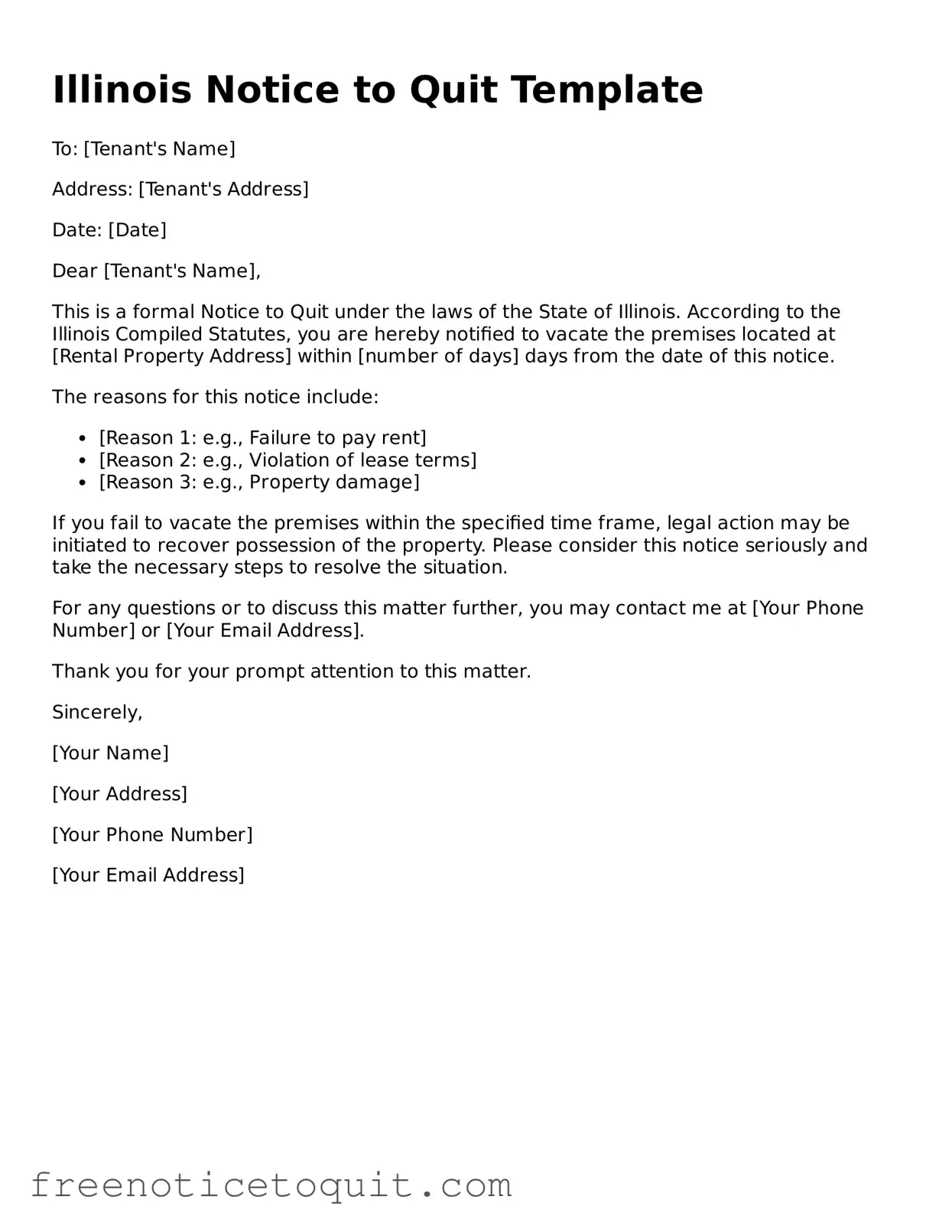
Illinois Notice to Quit Template

To: [Tenant's Name]

Address: [Tenant's Address]

Date: [Date]

Dear [Tenant's Name],

This is a formal Notice to Quit under the laws of the State of Illinois. According to the Illinois Compiled Statutes, you are hereby notified to vacate the premises located at [Rental Property Address] within [number of days] days from the date of this notice.

The reasons for this notice include:

  • [Reason 1: e.g., Failure to pay rent]
  • [Reason 2: e.g., Violation of lease terms]
  • [Reason 3: e.g., Property damage]

If you fail to vacate the premises within the specified time frame, legal action may be initiated to recover possession of the property. Please consider this notice seriously and take the necessary steps to resolve the situation.

For any questions or to discuss this matter further, you may contact me at [Your Phone Number] or [Your Email Address].

Thank you for your prompt attention to this matter.

Sincerely,

[Your Name]

[Your Address]

[Your Phone Number]

[Your Email Address]

PDF Data

Fact Name Description
Purpose The Illinois Notice to Quit form is used by landlords to formally notify tenants of their intent to terminate a lease agreement.
Governing Law This form is governed by the Illinois Compiled Statutes, specifically 735 ILCS 5/9-209.
Notice Period Typically, the notice period required is 5 days for non-payment of rent and 10 days for lease violations.
Delivery Method The notice can be delivered in person, sent via certified mail, or posted on the tenant's door.

Instructions on Utilizing Illinois Notice to Quit

After completing the Illinois Notice to Quit form, you will need to serve it to the tenant. This is an important step in the process of resolving any rental issues. Ensure you follow the correct procedures for serving the notice to maintain compliance with local laws.

  1. Begin by downloading the Illinois Notice to Quit form from a reliable source.
  2. Fill in the date at the top of the form. This is the date you are issuing the notice.
  3. Provide your name and address in the designated sections. This identifies you as the landlord.
  4. Next, enter the tenant's name and address. Ensure this information is accurate to avoid any delays.
  5. Specify the reason for the notice. Clearly state whether it is for non-payment of rent or another issue.
  6. Indicate the number of days the tenant has to vacate the property. This typically depends on the reason for the notice.
  7. Sign and date the form at the bottom. Your signature confirms that you are the landlord issuing the notice.
  8. Make a copy of the completed form for your records before serving it to the tenant.

FAQ

What is the Illinois Notice to Quit form?

The Illinois Notice to Quit form is a legal document used by landlords to inform tenants that they must vacate the rental property. This notice is typically the first step in the eviction process and serves as a formal notification that the tenant has violated the lease agreement or has not paid rent.

When should a landlord use a Notice to Quit?

A landlord should use a Notice to Quit when a tenant has failed to comply with the terms of the lease, such as not paying rent or violating other lease provisions. It can also be used when a landlord wishes to terminate a month-to-month rental agreement. The specific grounds for issuing the notice may vary depending on the situation.

How much notice must be given in the Notice to Quit?

The amount of notice required varies based on the reason for the eviction. For non-payment of rent, landlords typically must provide a 5-day notice. For lease violations, a 10-day notice is usually required. If the tenant is on a month-to-month lease, a 30-day notice may be necessary to terminate the tenancy.

What information must be included in the Notice to Quit?

The Notice to Quit should include the tenant's name, the address of the rental property, the reason for the notice, and the date by which the tenant must vacate. It is also important to include the landlord's contact information and any relevant lease provisions that have been violated.

Can a tenant respond to a Notice to Quit?

Yes, a tenant can respond to a Notice to Quit. They may choose to rectify the situation, such as paying overdue rent or addressing lease violations. If the tenant believes the notice is unjustified, they may also contest it in court once eviction proceedings are initiated.

What happens if a tenant does not comply with the Notice to Quit?

If a tenant does not comply with the Notice to Quit by the specified date, the landlord may proceed with legal action to evict the tenant. This typically involves filing an eviction lawsuit in the local court. The court will then schedule a hearing to determine the outcome.

Is the Notice to Quit the same as an eviction notice?

No, the Notice to Quit is not the same as an eviction notice. The Notice to Quit serves as a preliminary step, notifying the tenant of the need to vacate. An eviction notice is issued after the Notice to Quit has been ignored, and legal proceedings have begun.

Can a Notice to Quit be served electronically?

In Illinois, a Notice to Quit must be served in person or via certified mail. Electronic service is not typically permissible for this type of notice. Landlords should ensure they follow the proper procedures to avoid complications in the eviction process.

What should a landlord do if the tenant disputes the Notice to Quit?

If a tenant disputes the Notice to Quit, the landlord should be prepared to provide evidence supporting the notice. This may include lease agreements, payment records, or documentation of lease violations. If the dispute escalates, the landlord may need to pursue legal action to resolve the matter.

Are there any specific forms required for the Notice to Quit?

While there is no specific state-mandated form for the Notice to Quit, it is advisable for landlords to use a well-structured template that includes all necessary information. This helps ensure compliance with legal requirements and can aid in the eviction process if it becomes necessary.
Common mistakes

  1. Not including the correct address: It’s crucial to provide the complete and accurate address of the rental property. Omitting details can lead to delays or complications in the eviction process.

  2. Failing to specify the reason for the notice: The form requires you to state why you are issuing the Notice to Quit. Whether it’s for non-payment of rent or lease violations, clarity is key.

  3. Incorrectly calculating the notice period: Illinois law specifies the length of time that must be given in the notice. Ensure you understand whether it’s 5, 10, or 30 days, depending on the situation.

  4. Not signing the document: It may seem obvious, but forgetting to sign the Notice to Quit can invalidate the entire process. Always double-check that your signature is included.

  5. Using the wrong form: Different situations require different types of notices. Make sure you are using the appropriate Notice to Quit form for your specific circumstances.

  6. Not providing proper delivery: The law requires that the notice be delivered in a specific manner. Hand delivery, mail, or posting on the property are common methods, but ensure you follow the correct procedure.

  7. Ignoring local laws: Some municipalities have their own rules regarding eviction notices. Always check local regulations to ensure compliance.

  8. Neglecting to keep a copy: After filling out the form, it’s important to keep a copy for your records. This can be vital if the situation escalates to court.

Documents used along the form

When dealing with rental agreements and tenant evictions in Illinois, the Notice to Quit form is just one piece of the puzzle. It serves as a formal notice to a tenant, indicating that they must vacate the property. However, several other documents often accompany this form, each playing a crucial role in the process. Below is a list of essential forms and documents that may be used in conjunction with the Illinois Notice to Quit.

  • Lease Agreement: This document outlines the terms and conditions agreed upon by the landlord and tenant, including rent amount, duration of tenancy, and responsibilities of both parties.
  • Notice of Non-Renewal: If a landlord decides not to renew a lease at the end of its term, this notice informs the tenant that their lease will not be extended.
  • Eviction Complaint: This legal document initiates the formal eviction process. It is filed in court when a landlord seeks to remove a tenant who has not complied with the Notice to Quit.
  • Summons: Issued by the court, this document notifies the tenant of the eviction lawsuit and provides details about the court date and location.
  • Judgment Order: After the court hearing, this order outlines the court's decision regarding the eviction, including any judgments for unpaid rent or damages.
  • Writ of Possession: If the court rules in favor of the landlord, this document allows law enforcement to remove the tenant from the property if they do not leave voluntarily.
  • Security Deposit Return Form: This form is used to document the return of a tenant’s security deposit, detailing any deductions for damages or unpaid rent.
  • Tenant's Response to Eviction: A tenant may file this document to respond to the eviction complaint, providing their side of the story and any defenses they may have.
  • Payment Plan Agreement: If a tenant is behind on rent, this agreement outlines a plan for repayment that both the landlord and tenant can agree upon.
  • Property Condition Report: This document records the condition of the rental property at the time of move-in and move-out, which can be vital in disputes over damages.

Understanding these documents can greatly assist both landlords and tenants in navigating the complexities of rental agreements and eviction processes. Each form serves a specific purpose, ensuring that both parties are aware of their rights and responsibilities throughout the tenancy. Familiarity with these documents can lead to smoother interactions and potentially avoid conflicts down the line.

Similar forms

The Illinois Notice to Quit form is similar to the Eviction Notice, which is often used in many states. Both documents serve as formal notifications to tenants that they must vacate the premises. An Eviction Notice typically outlines the reasons for the eviction, such as non-payment of rent or lease violations. Like the Notice to Quit, it provides a specific timeframe within which the tenant must leave the property, ensuring that the landlord follows the proper legal procedures before pursuing further action.

Another document that shares similarities with the Illinois Notice to Quit is the Lease Termination Letter. This letter is usually sent by landlords to inform tenants that their lease will not be renewed or will be terminated for specific reasons. Both the Lease Termination Letter and the Notice to Quit require clear communication of the intent to end the tenancy, including the date by which the tenant must vacate. They both aim to provide tenants with a clear understanding of their obligations and the timeline for moving out.

The Demand for Possession is also comparable to the Illinois Notice to Quit. This document is typically used after a tenant has failed to pay rent or has violated lease terms. The Demand for Possession formally requests that the tenant vacate the property, similar to the Notice to Quit. Both documents emphasize the importance of adhering to the lease agreement and outline the consequences of failing to comply, which can lead to further legal action.

Lastly, the Notice of Non-Renewal is another document that aligns with the Illinois Notice to Quit. This notice is issued by landlords to inform tenants that their lease will not be extended beyond its current term. Like the Notice to Quit, the Notice of Non-Renewal specifies a deadline by which the tenant must vacate the property. Both documents are essential tools for landlords to communicate changes in tenancy and ensure that tenants are aware of their responsibilities as the lease term comes to an end.

Dos and Don'ts

When filling out the Illinois Notice to Quit form, it’s essential to follow certain guidelines to ensure accuracy and compliance with state laws. Here’s a list of things you should and shouldn't do:

  • Do clearly state the reason for the notice.
  • Do include the correct date when the notice is served.
  • Do provide the tenant’s full name and address.
  • Do keep a copy of the notice for your records.
  • Don't use vague language or general statements.
  • Don't forget to sign and date the notice.
  • Don't serve the notice without proper delivery methods.
  • Don't ignore local laws that may affect the notice.

Misconceptions

Many people have misunderstandings about the Illinois Notice to Quit form. Here are some common misconceptions:

  1. The Notice to Quit is the same as an eviction notice.

    While both documents are related to the eviction process, a Notice to Quit is a preliminary step. It informs the tenant that they must vacate the property, whereas an eviction notice is a formal legal action filed in court.

  2. All tenants receive the same Notice to Quit.

    The form can vary based on the reason for termination. Different situations, such as non-payment of rent or lease violations, may require different wording or notice periods.

  3. A Notice to Quit can be served verbally.

    In Illinois, a Notice to Quit must be provided in writing. Verbal notices do not hold legal weight and may not be enforceable in court.

  4. Tenants can ignore a Notice to Quit.

    Ignoring the notice can lead to legal consequences. If the tenant does not comply within the specified time frame, the landlord may proceed with eviction proceedings.

  5. Once a Notice to Quit is issued, the landlord cannot change their mind.

    A landlord may choose to withdraw the Notice to Quit before taking further legal action. However, once the eviction process has begun, it becomes more complicated.

  6. The Notice to Quit must be delivered in person.

    While personal delivery is one option, the notice can also be sent via certified mail or posted on the property, depending on the circumstances.

  7. A Notice to Quit guarantees eviction.

    Issuing a Notice to Quit does not automatically mean a tenant will be evicted. The process involves several steps, and a court must ultimately decide on the eviction.

  8. All landlords know how to properly fill out a Notice to Quit.

    Not all landlords are familiar with the legal requirements for the Notice to Quit. It is important for landlords to understand the correct procedure to avoid complications.

  9. Tenants have no rights after receiving a Notice to Quit.

    Tenants still have rights even after receiving this notice. They can contest the eviction in court and have the opportunity to present their case.

Key takeaways

When dealing with the Illinois Notice to Quit form, it is essential to understand its purpose and how to use it effectively. Here are some key takeaways:

  • The Notice to Quit is a formal document that a landlord uses to inform a tenant that they must vacate the rental property.
  • It is important to specify the reason for the eviction clearly, whether it’s for non-payment of rent or lease violations.
  • Ensure that the notice includes the correct address of the rental property to avoid any confusion.
  • Delivery of the Notice to Quit must be done in a manner that complies with Illinois law, which can include personal delivery or certified mail.
  • Keep a copy of the Notice to Quit for your records, as it may be needed for future legal proceedings.

Printable Notice to Quit Template for the State of Illinois

Open Notice to Quit Editor Here