Printable Notice to Quit Template for the State of Arkansas Open Notice to Quit Editor Here

Printable Notice to Quit Template for the State of Arkansas

The Arkansas Notice to Quit form is a legal document that a landlord uses to inform a tenant of their need to vacate the rental property. This form outlines the reasons for the eviction and provides a timeline for the tenant to respond. Understanding this form is crucial for both landlords and tenants to navigate the eviction process effectively.

The Arkansas Notice to Quit form serves as a crucial document in the landlord-tenant relationship, particularly when a landlord seeks to terminate a lease agreement. This form is typically issued to tenants who have either violated the terms of their lease or failed to pay rent on time. By providing a clear and formal notification, the Notice to Quit allows landlords to communicate their intention to end the tenancy, while also ensuring that tenants are aware of their rights and responsibilities. The form outlines essential details such as the reason for termination, the time frame within which tenants must vacate the property, and any necessary steps that need to be taken. Understanding the importance of this document is vital for both parties, as it helps prevent misunderstandings and lays the groundwork for any potential legal proceedings that may arise if the tenant does not comply. The process surrounding the Notice to Quit is designed to uphold fairness and transparency, ensuring that both landlords and tenants can navigate their rights and obligations effectively.

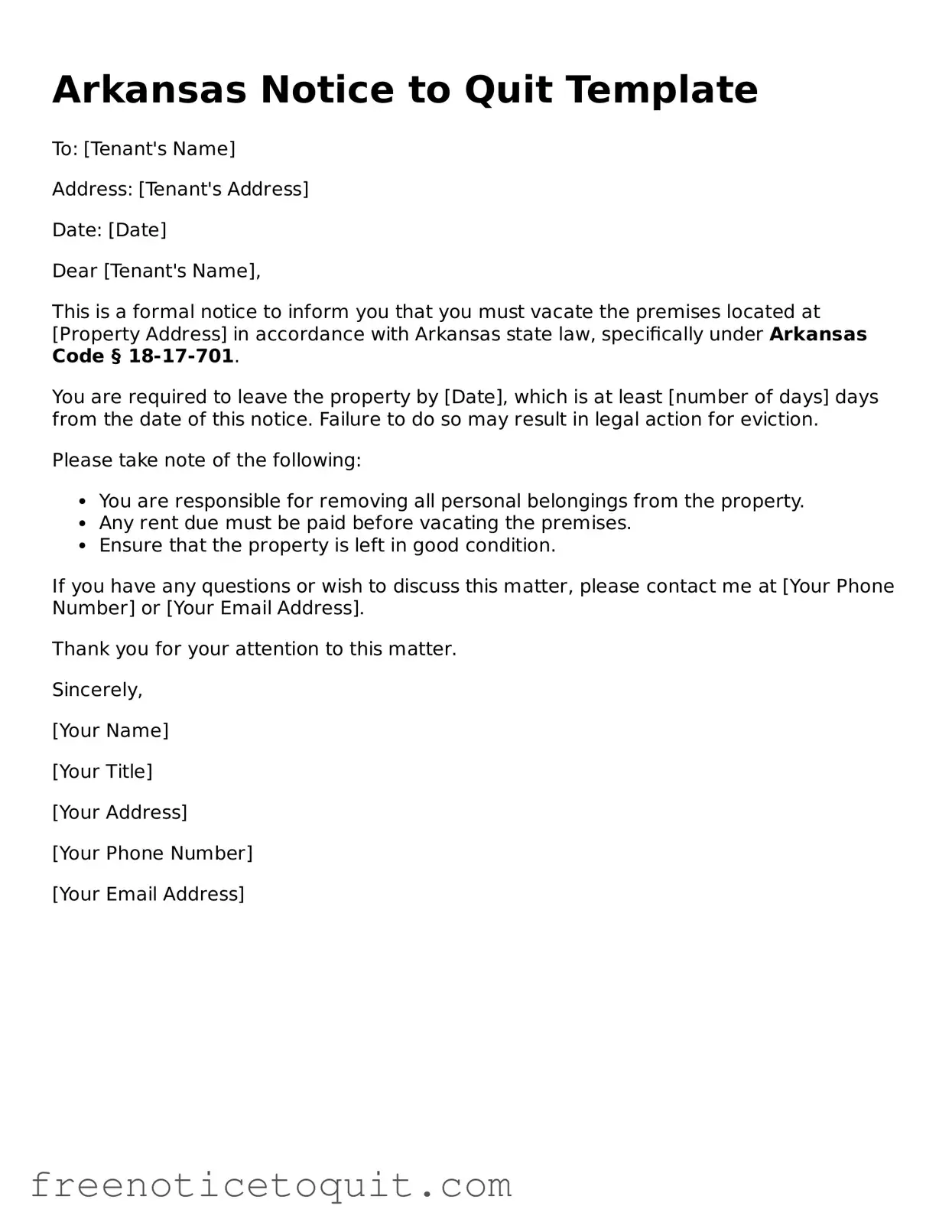
Arkansas Notice to Quit Sample

Arkansas Notice to Quit Template

To: [Tenant's Name]

Address: [Tenant's Address]

Date: [Date]

Dear [Tenant's Name],

This is a formal notice to inform you that you must vacate the premises located at [Property Address] in accordance with Arkansas state law, specifically under Arkansas Code § 18-17-701.

You are required to leave the property by [Date], which is at least [number of days] days from the date of this notice. Failure to do so may result in legal action for eviction.

Please take note of the following:

  • You are responsible for removing all personal belongings from the property.
  • Any rent due must be paid before vacating the premises.
  • Ensure that the property is left in good condition.

If you have any questions or wish to discuss this matter, please contact me at [Your Phone Number] or [Your Email Address].

Thank you for your attention to this matter.

Sincerely,

[Your Name]

[Your Title]

[Your Address]

[Your Phone Number]

[Your Email Address]

PDF Data

Fact Name Details
Purpose The Arkansas Notice to Quit form is used to inform a tenant that they must vacate the rental property.
Governing Law This form is governed by the Arkansas Code Annotated, Title 18, Chapter 17.
Notice Period Typically, a 30-day notice is required for month-to-month leases, but this can vary based on the lease agreement.
Delivery Methods The notice can be delivered in person, by mail, or through posting on the property.
Contents Required The form must include the tenant's name, address of the rental property, and the reason for termination.
Signature Requirement The landlord or their authorized agent must sign the notice to validate it.
Response Time Tenants typically have the duration of the notice period to respond or vacate the premises.
Legal Consequences If the tenant does not comply, the landlord may proceed with eviction proceedings.
Record Keeping Landlords should keep a copy of the notice for their records and proof of delivery.
Variations Different types of leases may require specific variations of the Notice to Quit form.

Instructions on Utilizing Arkansas Notice to Quit

After completing the Arkansas Notice to Quit form, the next step involves serving it to the tenant. This formal notification is essential to begin the process of eviction. Ensure that you follow the legal requirements for delivery to avoid any complications.

  1. Obtain a copy of the Arkansas Notice to Quit form. This can usually be found online or through local legal resources.
  2. Fill in your name and address in the designated section. This identifies you as the landlord.
  3. Enter the tenant's name and address accurately. Ensure that this information matches what is on the lease agreement.
  4. Specify the date the notice is being issued. This is important for tracking purposes.
  5. Clearly state the reason for the notice. Be concise and factual in your explanation.
  6. Indicate the time frame in which the tenant must vacate the property. This is typically a specific number of days as required by Arkansas law.
  7. Sign and date the form. Your signature confirms the authenticity of the notice.
  8. Make copies of the completed form for your records. This will be important for future reference.
  9. Deliver the notice to the tenant using an acceptable method, such as personal delivery, certified mail, or posting on the property.

FAQ

What is an Arkansas Notice to Quit form?

The Arkansas Notice to Quit form is a legal document used by landlords to notify tenants that they must vacate the rental property. This notice is typically issued when a tenant has violated the terms of their lease agreement or has failed to pay rent. It serves as a formal request for the tenant to leave the premises within a specified time frame.

When should a landlord use a Notice to Quit?

A landlord should use a Notice to Quit when a tenant has not complied with the lease agreement, such as failing to pay rent or engaging in illegal activities on the property. It can also be issued if the tenant is causing damage to the property or violating other lease terms. This notice is often the first step in the eviction process.

How much notice is required before a tenant must vacate?

The amount of notice required depends on the reason for the eviction. For non-payment of rent, Arkansas law typically requires a 14-day notice. For lease violations, the notice period can vary, but it is generally advisable to provide at least 30 days. Always check local laws for specific requirements.

Does a Notice to Quit need to be in writing?

Yes, a Notice to Quit must be in writing to be legally effective. The written notice should clearly state the reason for the eviction, the date by which the tenant must vacate, and any relevant details about the lease agreement. This documentation is important for legal proceedings if the situation escalates.

Can a tenant respond to a Notice to Quit?

A tenant can respond to a Notice to Quit, and it is advisable for them to do so. They may choose to rectify the issue, such as paying overdue rent, or they may contest the notice if they believe it is unjust. Communication between the landlord and tenant can sometimes resolve the issue without further legal action.

What happens if a tenant does not comply with a Notice to Quit?

If a tenant does not comply with a Notice to Quit, the landlord may proceed with the eviction process. This typically involves filing an eviction lawsuit in the local court. The court will then schedule a hearing where both parties can present their case. If the court rules in favor of the landlord, a judgment will be issued, allowing for the eviction to take place.

Is there a specific format for the Notice to Quit?

While there is no official state form for the Notice to Quit in Arkansas, it should include certain essential elements. These include the landlord's name and contact information, the tenant's name and address, a clear statement of the reason for the notice, the date by which the tenant must vacate, and the signature of the landlord or their representative.

Are there any legal protections for tenants regarding Notices to Quit?

Yes, tenants in Arkansas have legal protections. Landlords must follow proper legal procedures when issuing a Notice to Quit and cannot retaliate against tenants for exercising their rights. If a tenant believes they have been wrongfully served a Notice to Quit or that their rights have been violated, they should seek legal advice to understand their options.
Common mistakes

  1. Incorrect Tenant Information: One common mistake is failing to provide accurate information about the tenant. Ensure that the tenant's full name and address are correctly entered. Any discrepancies can lead to delays or complications in the eviction process.

  2. Missing Signature: A signature is a crucial part of the Notice to Quit. Omitting this can render the document invalid. Always double-check to ensure that the form is signed by the appropriate party.

  3. Inadequate Notice Period: The form must specify the correct notice period required by Arkansas law. Failing to provide the required number of days can jeopardize the eviction process. Familiarize yourself with the legal requirements to avoid this error.

  4. Failure to Deliver Properly: After filling out the form, it is essential to deliver it correctly. This means following the legal guidelines for serving the notice to the tenant. Improper delivery can invalidate the notice and prolong the eviction process.

Documents used along the form

When dealing with a rental situation in Arkansas, the Notice to Quit form is often accompanied by other important documents. These forms help clarify the rights and responsibilities of both landlords and tenants. Here are five commonly used forms that may be relevant:

  • Lease Agreement: This document outlines the terms of the rental arrangement, including the duration of the lease, rent amount, and responsibilities of both parties.
  • Notice of Non-Payment of Rent: This notice informs the tenant that their rent is overdue. It typically provides a deadline for payment before further action is taken.
  • Eviction Complaint: If the situation escalates, this document is filed with the court to initiate the eviction process. It outlines the reasons for eviction and requests a court hearing.
  • Affidavit of Service: This form proves that the Notice to Quit or other legal documents were properly delivered to the tenant, which is crucial for legal proceedings.
  • Move-Out Inspection Checklist: This checklist helps document the condition of the rental unit when a tenant moves out, which can be important for security deposit disputes.

Understanding these documents can help ensure that both landlords and tenants are aware of their rights and obligations. Having the right forms on hand can make the process smoother and more transparent for everyone involved.

Similar forms

The Arkansas Notice to Quit form serves a specific purpose in the eviction process, but several other documents share similar functions in various states or contexts. One such document is the Lease Termination Notice. This notice is typically used by landlords to inform tenants that their lease will not be renewed at the end of its term. Like the Notice to Quit, it provides a formal communication that outlines the end of the rental agreement and the expectation for the tenant to vacate the premises.

Another similar document is the Eviction Notice, often referred to as a Summons or Complaint for Eviction in some jurisdictions. This legal document is filed by a landlord when they seek to initiate eviction proceedings in court. It outlines the reasons for eviction, such as non-payment of rent or lease violations, and informs the tenant of their rights and the legal process ahead. Both the Eviction Notice and the Notice to Quit serve as formal notifications to tenants regarding their housing situation.

The 30-Day Notice to Vacate is also comparable to the Arkansas Notice to Quit. This document is commonly used by landlords or tenants to provide a month’s notice before terminating a month-to-month rental agreement. It serves as a way to ensure that both parties have adequate time to make necessary arrangements. Similar to the Notice to Quit, it is a clear communication that sets expectations for the end of tenancy.

A Rent Demand Notice is another document that shares similarities. This notice is issued by landlords when tenants fail to pay rent on time. It typically demands payment within a specified timeframe, often before further legal action is taken. While its primary focus is on rent collection, it can lead to eviction proceedings if the issue is not resolved, much like the Notice to Quit.

The Notice of Non-Renewal is also relevant in this context. It is issued by landlords to inform tenants that their lease will not be renewed upon expiration. This notice is essential for providing clarity and allowing tenants to prepare for their next steps. Like the Notice to Quit, it serves to formally communicate the end of the rental agreement.

In some cases, a Cure or Quit Notice may be used. This document notifies tenants of a lease violation and gives them an opportunity to correct the issue within a specified timeframe or face eviction. It shares the same goal as the Notice to Quit, which is to inform tenants of their obligations under the lease and the consequences of failing to comply.

Lastly, the Conditional Quit Notice is similar in that it outlines specific conditions under which a tenant must vacate the property. This notice often relates to lease violations and provides a timeline for compliance. Both the Conditional Quit Notice and the Arkansas Notice to Quit emphasize the importance of adhering to lease terms and the potential for eviction if those terms are not met.

Dos and Don'ts

When filling out the Arkansas Notice to Quit form, it’s important to follow certain guidelines to ensure the process goes smoothly. Here are six things you should and shouldn't do:

  • Do provide accurate information about the tenant and the property.
  • Do clearly state the reason for the notice.
  • Do include the date by which the tenant must vacate the premises.
  • Don't use vague language or general statements.
  • Don't forget to sign and date the notice.
  • Don't assume that verbal communication is sufficient; always provide a written notice.

By following these tips, you can help ensure that your Notice to Quit is effective and legally sound.

Misconceptions

The Arkansas Notice to Quit form is an important document in the eviction process, but several misconceptions surround its use. Here are nine common misunderstandings:

  1. The Notice to Quit is the same as an eviction notice. Many people believe that these two terms are interchangeable. However, the Notice to Quit is a preliminary step that informs the tenant of the landlord's intent to terminate the lease, while an eviction notice is a legal action that follows if the tenant does not vacate the property.

  2. A Notice to Quit can be issued for any reason. Some individuals think landlords can issue this notice at any time. In reality, a Notice to Quit must be based on specific grounds, such as non-payment of rent or lease violations, depending on state law.

  3. All tenants receive the same notice period. There is a misconception that the notice period is uniform for all situations. In Arkansas, the required notice period can vary based on the reason for termination, such as 14 days for non-payment of rent or 30 days for lease violations.

  4. The form must be filed with the court. Some believe that the Notice to Quit must be filed with a court to be valid. However, this form is typically delivered directly to the tenant and does not require court filing.

  5. Tenants can ignore the Notice to Quit. There is a notion that tenants can disregard this notice without consequences. Ignoring it can lead to legal action, including eviction proceedings, if the tenant does not respond or vacate the property.

  6. A verbal notice is sufficient. Some individuals think that a verbal notice is adequate. However, written notice is required in Arkansas to ensure clarity and provide a record of communication.

  7. The landlord must provide a reason for the notice. Many tenants believe that landlords are obligated to explain their reasons. While it is advisable for landlords to state the reason, it is not legally required for the Notice to Quit itself.

  8. Once the notice is served, the tenant must leave immediately. Some assume that tenants must vacate the premises immediately upon receiving the notice. In fact, tenants typically have a specified period to comply with the notice before further legal action can be taken.

  9. The Notice to Quit is not necessary if the lease has expired. There is a belief that landlords do not need to provide a Notice to Quit if the lease term has ended. However, it is still advisable to issue this notice to formally communicate the end of the tenancy.

Understanding these misconceptions can help both landlords and tenants navigate the eviction process more effectively and compassionately.

Key takeaways

Filling out and using the Arkansas Notice to Quit form is an important step for landlords seeking to terminate a rental agreement. Here are some key takeaways to keep in mind:

  1. Understand the Purpose: The Notice to Quit is used to inform tenants that they must vacate the property, typically due to non-payment of rent or lease violations.
  2. Know the Required Information: Ensure that the form includes the tenant's name, the property address, and the specific reason for the notice.
  3. Specify the Timeframe: Arkansas law requires landlords to provide a specific period for tenants to respond or vacate. This timeframe can vary depending on the reason for the notice.
  4. Delivery Methods Matter: The Notice to Quit must be delivered in a manner that complies with state law, which may include personal delivery, certified mail, or posting on the property.
  5. Keep Records: Maintain copies of the Notice to Quit and any correspondence with the tenant. This documentation can be crucial if further legal action is necessary.
  6. Consult Local Laws: Local ordinances may have additional requirements or procedures for eviction notices. Always check for any specific rules in your area.
  7. Consider Legal Advice: If unsure about the process or the implications of issuing a Notice to Quit, seeking guidance from a legal professional can be beneficial.

By following these takeaways, landlords can navigate the eviction process more effectively and ensure compliance with Arkansas laws.

Printable Notice to Quit Template for the State of Arkansas

Open Notice to Quit Editor Here