Printable Notice to Quit Template for the State of Maine Open Notice to Quit Editor Here

Printable Notice to Quit Template for the State of Maine

The Maine Notice to Quit form is a legal document used by landlords to inform tenants that they must vacate the rental property. This notice outlines the reasons for termination of the lease and provides a timeline for the tenant to leave. Understanding this form is crucial for both landlords and tenants to ensure compliance with state laws and to protect their rights.

The Maine Notice to Quit form is a crucial document in the landlord-tenant relationship, serving as a formal request for tenants to vacate a rental property. This form is typically used when a landlord seeks to terminate a lease agreement due to various reasons, such as non-payment of rent, violation of lease terms, or other just causes. It outlines the specific grounds for eviction and provides a clear timeline for the tenant to respond or vacate. The form must be completed accurately to ensure compliance with state laws, which dictate the notice period and required information. Understanding the nuances of this form is essential for both landlords and tenants, as it protects the rights of both parties while facilitating a clear communication process. Proper use of the Notice to Quit can help prevent misunderstandings and potential legal disputes, making it an important tool in property management.

Maine Notice to Quit Sample

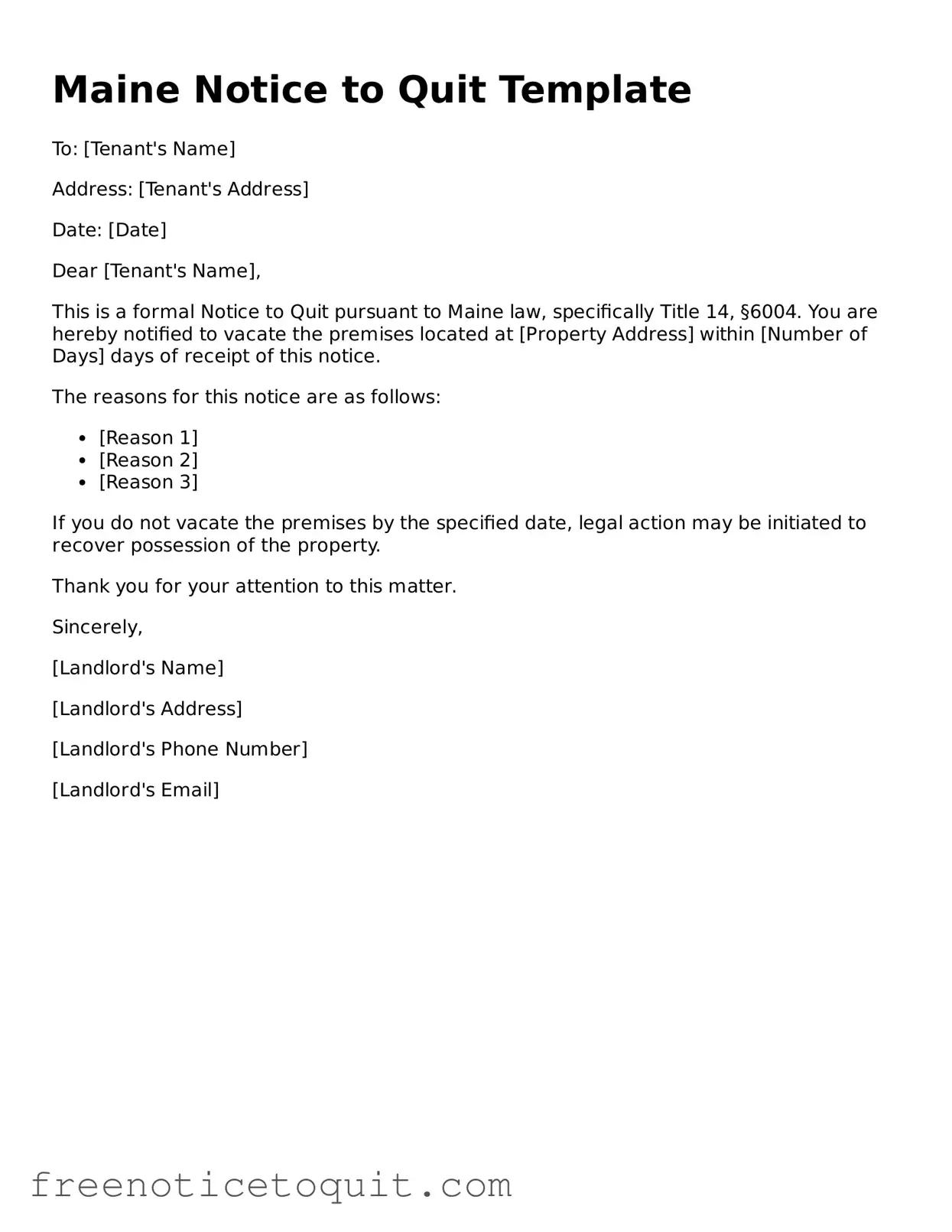
Maine Notice to Quit Template

To: [Tenant's Name]

Address: [Tenant's Address]

Date: [Date]

Dear [Tenant's Name],

This is a formal Notice to Quit pursuant to Maine law, specifically Title 14, §6004. You are hereby notified to vacate the premises located at [Property Address] within [Number of Days] days of receipt of this notice.

The reasons for this notice are as follows:

  • [Reason 1]
  • [Reason 2]
  • [Reason 3]

If you do not vacate the premises by the specified date, legal action may be initiated to recover possession of the property.

Thank you for your attention to this matter.

Sincerely,

[Landlord's Name]

[Landlord's Address]

[Landlord's Phone Number]

[Landlord's Email]

PDF Data

Fact Name Description
Purpose The Maine Notice to Quit form is used by landlords to inform tenants that they must vacate the rental property. This notice is typically issued when a tenant has violated lease terms or failed to pay rent.
Notice Period In Maine, the notice period can vary depending on the reason for eviction. Generally, landlords must provide a 7-day notice for non-payment of rent and a 30-day notice for lease violations.
Governing Laws The Maine Notice to Quit is governed by the Maine Revised Statutes, Title 14, Chapter 710, which outlines the legal requirements and procedures for eviction notices.
Delivery Method The notice must be delivered to the tenant in person or sent via certified mail. Proper delivery ensures that the tenant is aware of the eviction process.

Instructions on Utilizing Maine Notice to Quit

Once you have the Maine Notice to Quit form in hand, it's time to fill it out carefully. This document serves as an important step in the process of addressing tenancy issues. Completing it accurately is crucial for ensuring that all parties understand their rights and responsibilities moving forward.

  1. Begin by entering the date at the top of the form. This is the date you are issuing the Notice to Quit.
  2. Next, provide your name and address in the designated fields. This identifies you as the landlord.
  3. Fill in the tenant's name and address. Ensure that this information is correct to avoid any confusion.
  4. Specify the reason for the Notice to Quit. Be clear and concise, whether it’s for non-payment of rent or another issue.
  5. Indicate the date by which the tenant must vacate the premises. This is typically a specific number of days from the date you issued the notice.
  6. Sign the form. Your signature confirms that you are the landlord and that you are formally issuing this notice.
  7. Make a copy of the completed form for your records. Keeping a copy ensures you have proof of the notice in case of future disputes.
  8. Deliver the Notice to Quit to the tenant. This can be done in person or through certified mail, depending on your preference.

FAQ

What is a Maine Notice to Quit form?

The Maine Notice to Quit form is a legal document that a landlord uses to inform a tenant that they must vacate the rental property. This notice is typically used when a tenant has violated the lease agreement, failed to pay rent, or if the landlord wishes to terminate a month-to-month tenancy. The notice provides the tenant with a specific timeframe to leave the property, which is usually seven days for non-payment of rent or 30 days for other lease violations.

How does a landlord properly serve a Notice to Quit?

A landlord can serve a Notice to Quit in several ways. The most common methods include personal delivery to the tenant or sending it via certified mail. If the tenant cannot be found, the notice can be posted on the property in a visible location. It is essential that the landlord keeps a record of how and when the notice was served, as this information may be important in any future legal proceedings.

What should be included in the Notice to Quit?

The Notice to Quit should clearly state the reason for the eviction, whether it’s due to non-payment of rent or another lease violation. It must also specify the date by which the tenant must vacate the property. Additionally, it should include the landlord’s contact information and any relevant details about the lease agreement. Clarity is key to ensuring that the tenant understands the situation and their obligations.

What happens if the tenant does not leave by the deadline?

If the tenant does not vacate the property by the deadline stated in the Notice to Quit, the landlord may proceed with legal action. This often involves filing an eviction lawsuit, known as a forcible entry and detainer action, in the local court. The court will then schedule a hearing to determine whether the eviction is justified. It’s important for landlords to follow the legal process to avoid complications.

Can a tenant dispute a Notice to Quit?

Yes, a tenant can dispute a Notice to Quit. If they believe the notice is unjust or that they have resolved the issue, they can communicate with the landlord to discuss the situation. If necessary, the tenant may also present their case in court during the eviction hearing. It’s advisable for tenants to gather any relevant evidence, such as payment records or correspondence with the landlord, to support their claims.

Common mistakes

  1. Incorrect Tenant Information: Failing to accurately list the tenant's full name and current address can lead to confusion and delays. Ensure all details are up-to-date and correctly spelled.

  2. Missing Landlord Information: Just as tenant details are crucial, providing incomplete or incorrect landlord information can complicate the process. Include your full name and contact details.

  3. Improper Notice Period: Maine law requires a specific notice period depending on the reason for eviction. Ignoring these timelines can invalidate the notice. Verify the required notice period based on the situation.

  4. Failure to State the Reason for Termination: A clear reason for the notice must be included. Vague or ambiguous language can lead to misunderstandings. Be specific about the grounds for eviction.

  5. Not Signing the Form: A Notice to Quit must be signed by the landlord or their authorized agent. Omitting a signature renders the document ineffective. Always double-check that the form is signed.

  6. Neglecting to Deliver the Notice Properly: Simply filling out the form is not enough; it must be delivered according to legal requirements. Understand the acceptable methods of delivery to ensure compliance.

Documents used along the form

When dealing with tenancy issues in Maine, the Notice to Quit form is often accompanied by several other important documents. These documents help clarify the process and ensure that all parties understand their rights and obligations. Below is a list of commonly used forms along with brief descriptions of each.

  • Lease Agreement: This document outlines the terms and conditions of the rental arrangement between the landlord and tenant. It includes details such as the rental amount, duration of the lease, and responsibilities of both parties.
  • Rent Payment Receipt: This is a record provided by the landlord to the tenant, confirming that rent has been received for a specific period. It serves as proof of payment and can be useful in disputes.
  • Eviction Notice: This formal notice is issued when a landlord seeks to terminate a tenancy due to specific violations, such as non-payment of rent or lease violations. It provides the tenant with information on the reason for eviction and any necessary steps to remedy the situation.
  • Response to Notice to Quit: Tenants may use this document to formally respond to a Notice to Quit. It can outline their reasons for contesting the notice or indicate their intention to vacate the premises.
  • Affidavit of Service: This document serves as proof that the Notice to Quit or other legal documents were properly delivered to the tenant. It details how and when the documents were served.

These documents play a critical role in the rental process and help ensure that both landlords and tenants are informed of their rights and responsibilities. Understanding these forms can help prevent misunderstandings and facilitate smoother interactions between parties.

Similar forms

The Maine Notice to Quit form is similar to the Eviction Notice used in many states. Both documents serve as formal notifications to tenants regarding their lease violations or the need to vacate the property. An Eviction Notice typically outlines the reason for the eviction, such as non-payment of rent or breach of lease terms. Like the Notice to Quit, it sets a specific timeframe for the tenant to leave the premises, ensuring that both parties understand their rights and responsibilities during the eviction process.

Another document comparable to the Maine Notice to Quit is the Lease Termination Notice. This form is used when a landlord wishes to end a lease agreement for reasons other than tenant misconduct. It informs the tenant of the intention to terminate the lease and specifies the last date of tenancy. Similar to the Notice to Quit, it provides a clear timeline for the tenant to vacate, thereby preventing misunderstandings about the end of the lease period.

The Conditional Quit Notice is also akin to the Maine Notice to Quit. This document is issued when a tenant has violated specific lease terms, such as causing damage to the property or disturbing neighbors. The Conditional Quit Notice details the violations and gives the tenant a chance to remedy the situation within a specified time frame. If the tenant fails to comply, they must vacate the premises, paralleling the process outlined in the Notice to Quit.

The Three-Day Notice to Pay Rent or Quit shares similarities with the Maine Notice to Quit, particularly in cases of non-payment. This document specifically addresses situations where rent has not been paid. It provides the tenant with three days to pay the overdue rent or face eviction. The urgency and clarity of both notices aim to prompt action from the tenant, ensuring that landlords can address payment issues promptly.

The 30-Day Notice to Vacate is another document that resembles the Maine Notice to Quit. This notice is often used by landlords to inform tenants that they must vacate the property within 30 days. It is typically issued without cause, allowing landlords to end a tenancy for any reason. Both documents emphasize the importance of clear communication regarding the end of tenancy, ensuring that tenants have adequate time to find new housing.

Lastly, the Notice of Default is similar to the Maine Notice to Quit in that it addresses lease violations. This document is often used in the context of mortgages but can apply to rental agreements as well. It notifies the tenant of their default status, such as missed rent payments, and outlines the steps they must take to remedy the situation. Like the Notice to Quit, it serves as a formal warning that further action may be taken if the issues are not resolved within a specified timeframe.

Dos and Don'ts

When filling out the Maine Notice to Quit form, it is important to approach the process with care. Here are some guidelines to help ensure that you complete the form correctly and effectively.

  • Do provide accurate information about the tenant and the rental property.
  • Do clearly state the reason for the notice.
  • Do ensure that you sign and date the form.
  • Don't use vague language that may confuse the tenant.
  • Don't forget to keep a copy of the notice for your records.

By following these guidelines, you can help ensure that the notice is valid and serves its intended purpose. Clear communication is key in these situations.

Misconceptions

When dealing with the Maine Notice to Quit form, misunderstandings can lead to unnecessary confusion. Here are eight common misconceptions about this important document:

  • It can be used for any type of eviction. The Notice to Quit is specifically for terminating a lease, not for evicting a tenant for reasons unrelated to lease violations.
  • It must be served in person. While personal service is one option, the Notice to Quit can also be sent via certified mail, making it more flexible.
  • All tenants receive the same notice period. The notice period can vary depending on the reason for termination. For example, a nonpayment of rent typically requires a 7-day notice, while other lease violations may require a longer period.
  • Once served, the tenant must leave immediately. The tenant has the right to remain in the property until the notice period expires, even after receiving the Notice to Quit.
  • The form does not need to be in writing. A written Notice to Quit is essential. Verbal notices do not fulfill legal requirements and can lead to complications.
  • Landlords can create their own version of the form. While landlords may include specific details, they must adhere to the state’s legal requirements for the Notice to Quit.
  • It guarantees eviction. Serving a Notice to Quit is only the first step in the eviction process. If the tenant does not leave, landlords must file for eviction in court.
  • Only the landlord can issue a Notice to Quit. In some cases, a property manager or authorized agent can serve the notice on behalf of the landlord, provided they have the proper authority.

Understanding these misconceptions can help both landlords and tenants navigate the eviction process more effectively. Clarity around the Notice to Quit form is crucial for maintaining a fair rental relationship.

Key takeaways

When dealing with the Maine Notice to Quit form, it is important to understand its purpose and how to use it effectively. Here are some key takeaways:

  • The Notice to Quit is a legal document that a landlord uses to inform a tenant that they must vacate the rental property.
  • It is essential to fill out the form accurately, including the tenant's name, address, and the reason for the notice.
  • The notice must be delivered to the tenant in person or sent via certified mail to ensure proper documentation.
  • In Maine, the notice period can vary depending on the reason for eviction, so be sure to check the specific requirements.
  • Keep a copy of the Notice to Quit for your records, as this may be needed in future legal proceedings.
  • Failure to follow the proper procedure when issuing a Notice to Quit can result in delays or dismissal of eviction proceedings.
  • If the tenant does not comply with the notice, the landlord may proceed with filing for eviction in court.

Understanding these key points can help ensure a smoother process when using the Maine Notice to Quit form.

Printable Notice to Quit Template for the State of Maine

Open Notice to Quit Editor Here