Printable Notice to Quit Template for the State of Montana Open Notice to Quit Editor Here

Printable Notice to Quit Template for the State of Montana

The Montana Notice to Quit form is a legal document used by landlords to formally notify tenants that they must vacate the rental property. This notice outlines the reasons for termination and provides a specified timeframe for the tenant to leave. Understanding this form is crucial for both landlords and tenants to ensure compliance with state laws and to protect their rights.

The Montana Notice to Quit form is an essential document for landlords and tenants navigating the complexities of rental agreements. This form serves as a formal notification from a landlord to a tenant, indicating the need to vacate the premises within a specified timeframe. It is crucial for landlords to provide this notice when a tenant has violated lease terms, failed to pay rent, or engaged in illegal activities. The form outlines the reasons for eviction and includes important details such as the date by which the tenant must leave the property. Tenants, on the other hand, should understand their rights and the implications of receiving such a notice. Completing the Notice to Quit accurately and following the proper procedures can help both parties avoid potential disputes and ensure a smoother transition, whether it involves moving out or addressing the issues at hand.

Montana Notice to Quit Sample

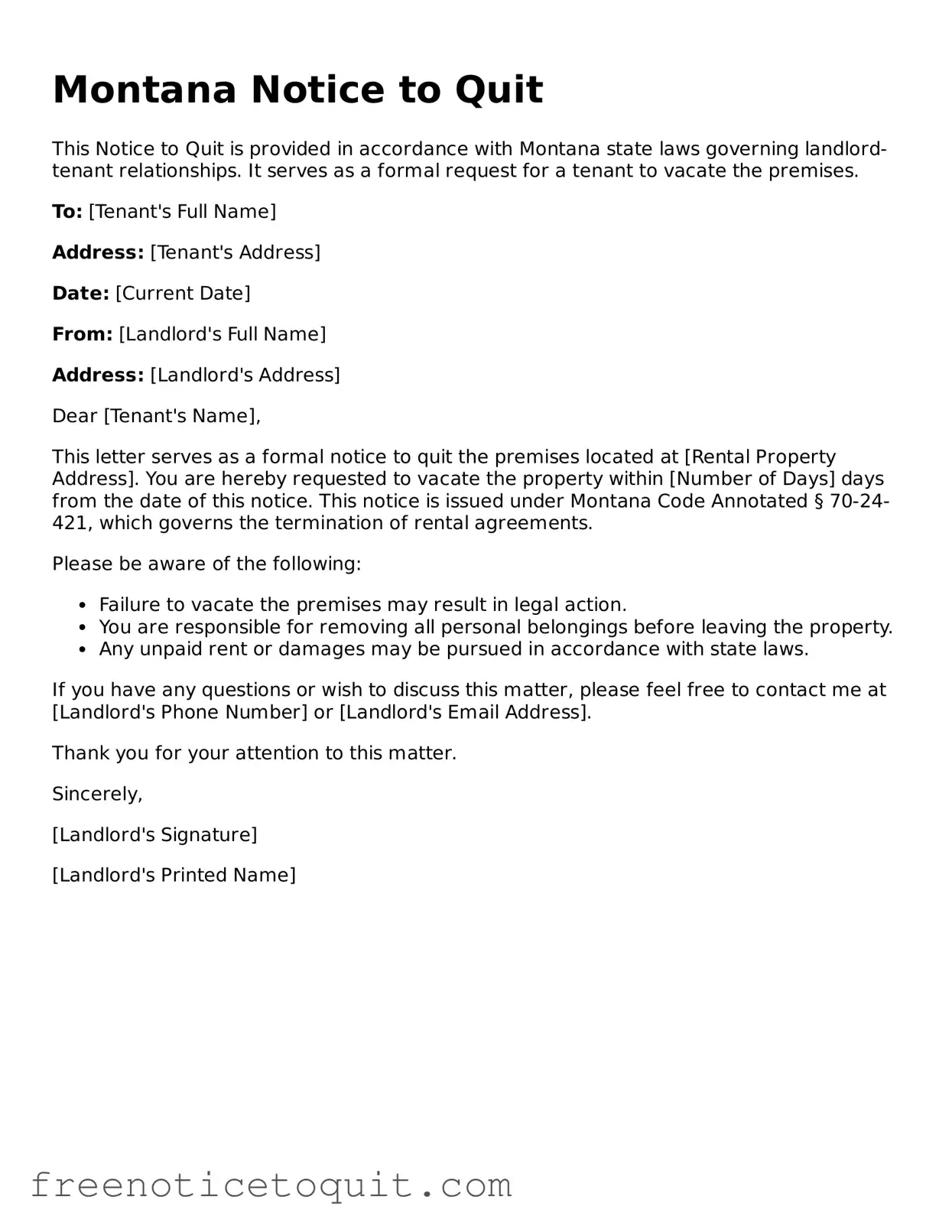
Montana Notice to Quit

This Notice to Quit is provided in accordance with Montana state laws governing landlord-tenant relationships. It serves as a formal request for a tenant to vacate the premises.

To: [Tenant's Full Name]

Address: [Tenant's Address]

Date: [Current Date]

From: [Landlord's Full Name]

Address: [Landlord's Address]

Dear [Tenant's Name],

This letter serves as a formal notice to quit the premises located at [Rental Property Address]. You are hereby requested to vacate the property within [Number of Days] days from the date of this notice. This notice is issued under Montana Code Annotated § 70-24-421, which governs the termination of rental agreements.

Please be aware of the following:

  • Failure to vacate the premises may result in legal action.
  • You are responsible for removing all personal belongings before leaving the property.
  • Any unpaid rent or damages may be pursued in accordance with state laws.

If you have any questions or wish to discuss this matter, please feel free to contact me at [Landlord's Phone Number] or [Landlord's Email Address].

Thank you for your attention to this matter.

Sincerely,

[Landlord's Signature]

[Landlord's Printed Name]

PDF Data

Fact Name Description
Purpose The Montana Notice to Quit form is used by landlords to formally notify tenants of the need to vacate the rental property.
Governing Law This form is governed by Montana Code Annotated, Title 70, Chapter 24, which outlines landlord-tenant relationships.
Notice Period In most cases, landlords must provide a 30-day notice for month-to-month leases before terminating the tenancy.
Delivery Methods The notice can be delivered in person, by mail, or posted on the rental property, ensuring that the tenant receives it.
Tenant Rights Tenants have the right to contest the notice in court if they believe it was issued improperly or without cause.

Instructions on Utilizing Montana Notice to Quit

Once you have the Montana Notice to Quit form in hand, you’ll need to complete it carefully. This form is essential for communicating your intentions clearly and legally. Follow the steps below to ensure you fill it out correctly.

  1. Begin by entering the date at the top of the form. This should be the date you are filling out the notice.
  2. Next, provide your name and address. This is important as it identifies you as the landlord or property owner.
  3. Then, include the tenant's name and address. Make sure to write it exactly as it appears in your lease agreement.
  4. Specify the reason for the notice. You may need to check specific regulations to ensure you are compliant with Montana law.
  5. Clearly state the time frame for the tenant to vacate the property. This is usually a set number of days based on the reason for the notice.
  6. Sign the form at the bottom. Your signature confirms that the information provided is accurate and that you are formally issuing the notice.
  7. Finally, make a copy of the completed form for your records before delivering it to the tenant.

After completing the form, you will need to deliver it to the tenant. Ensure that you follow the appropriate method of delivery, as this can impact the validity of the notice. Keep track of the delivery date, as it is crucial for any further legal steps you may need to take.

FAQ

What is a Montana Notice to Quit form?

The Montana Notice to Quit form is a legal document used by landlords to notify tenants that they must vacate the rental property. This notice is typically issued when a tenant has violated the terms of their lease agreement or failed to pay rent. It serves as a formal communication that outlines the reasons for the eviction and provides a timeline for the tenant to vacate the premises.

How much notice is required in a Montana Notice to Quit?

The amount of notice required can vary depending on the reason for the eviction. Generally, landlords must provide a 30-day notice for most lease violations or non-payment of rent. However, if the tenant has engaged in illegal activity or has caused significant damage to the property, a shorter notice period may apply. It is essential for landlords to follow the specific requirements outlined in Montana law.

What should be included in a Montana Notice to Quit?

A Montana Notice to Quit should include several key elements. It must state the date of the notice, the names of the landlord and tenant, the address of the rental property, and the specific reasons for the eviction. Additionally, the notice should clearly indicate the deadline by which the tenant must vacate the property. Providing this information helps ensure that the notice is legally valid and that the tenant understands their obligations.

Can a tenant contest a Notice to Quit in Montana?

Yes, a tenant has the right to contest a Notice to Quit. If a tenant believes the notice is unjust or that they have not violated the lease terms, they can respond to the landlord. In some cases, tenants may choose to seek legal assistance to address their concerns. If the matter escalates, it may ultimately be resolved in court, where both parties can present their arguments.

What happens if a tenant does not comply with the Notice to Quit?

If a tenant fails to comply with the Notice to Quit by the specified deadline, the landlord may proceed with eviction proceedings. This typically involves filing an eviction lawsuit in the local court. The court will then schedule a hearing where both the landlord and tenant can present their cases. If the court rules in favor of the landlord, the tenant may be ordered to vacate the property and could face additional legal consequences.

Common mistakes

  1. Failing to provide accurate tenant information. Ensure that the tenant's full name and address are correct. Mistakes in this section can lead to delays or complications in the eviction process.

  2. Not specifying the reason for the notice. Montana law requires that the reason for the eviction be clearly stated. Whether it's for non-payment of rent or lease violations, clarity is crucial.

  3. Incorrectly calculating the notice period. Depending on the reason for the eviction, the required notice period can vary. Double-check the timeframe to ensure compliance with state laws.

  4. Neglecting to sign and date the form. A Notice to Quit must be signed by the landlord or their authorized agent. Without a signature and date, the notice may be deemed invalid.

Documents used along the form

When dealing with tenancy issues in Montana, the Notice to Quit form is often used as a formal communication to a tenant regarding lease violations or the termination of a rental agreement. However, several other documents may accompany this form to ensure a comprehensive approach to the situation. Below is a list of common forms and documents that may be utilized alongside the Notice to Quit.

  • Lease Agreement: This is the foundational document that outlines the terms and conditions of the rental arrangement between the landlord and tenant. It specifies rent amounts, payment schedules, and responsibilities of both parties.
  • Notice of Rent Increase: If a landlord wishes to raise the rent, this notice is required to inform tenants of the new rental rate and the effective date. It ensures compliance with state laws regarding rent increases.
  • Eviction Notice: This document is issued when a landlord seeks to formally begin the eviction process. It provides details about the reasons for eviction and the timeline for the tenant to vacate the property.
  • Repair Request Form: Tenants may use this form to formally request necessary repairs in the rental unit. It documents the issue and helps ensure that landlords fulfill their maintenance obligations.
  • Move-Out Checklist: This checklist is often provided to tenants to guide them through the moving-out process. It helps ensure that the property is returned in good condition and can assist in the return of the security deposit.

Utilizing these documents in conjunction with the Montana Notice to Quit can help both landlords and tenants navigate the complexities of rental agreements and ensure that all parties are aware of their rights and responsibilities. Clear communication and proper documentation are key to maintaining a healthy landlord-tenant relationship.

Similar forms

The Montana Notice to Quit form shares similarities with the Eviction Notice. Both documents serve as formal notifications to tenants regarding their lease agreements. An Eviction Notice typically specifies the reasons for the eviction, such as non-payment of rent or violation of lease terms. Similarly, the Notice to Quit informs tenants that they must vacate the premises, providing them with a timeline to do so. The main purpose of both documents is to initiate the process of removing a tenant from a rental property.

Another document that resembles the Montana Notice to Quit is the Lease Termination Letter. This letter is often used by landlords to inform tenants that their lease will not be renewed at the end of its term. Like the Notice to Quit, it outlines the need for the tenant to vacate the property. However, the Lease Termination Letter is typically issued at the conclusion of a lease period, while the Notice to Quit can be issued during an active lease for specific violations.

The 30-Day Notice to Vacate is also similar to the Montana Notice to Quit. This notice gives tenants a full month to vacate the property, allowing them adequate time to find alternative housing. Both documents require clear communication from the landlord to the tenant, detailing the need to leave the premises. The 30-Day Notice is often used in month-to-month rental agreements, while the Notice to Quit may address more immediate concerns.

The Pay or Quit Notice is another document that aligns closely with the Montana Notice to Quit. This notice is specifically issued when a tenant has failed to pay rent. It demands that the tenant either pay the overdue rent or vacate the property within a specified timeframe. Both notices serve as a warning to tenants, but the Pay or Quit Notice focuses exclusively on financial obligations, while the Notice to Quit may address various lease violations.

The Cure or Quit Notice is similar in that it addresses lease violations, giving tenants a chance to rectify the issue before eviction proceedings begin. This notice specifies the violation, such as unauthorized pets or property damage, and provides a timeframe for the tenant to correct the issue. The Montana Notice to Quit may also serve as a final warning before legal action is taken, making both documents crucial in the landlord-tenant relationship.

The Notice of Non-Renewal is another document akin to the Montana Notice to Quit. This notice informs tenants that their lease will not be extended or renewed. While the Notice to Quit often pertains to immediate violations, the Notice of Non-Renewal is more about future tenancy. Both documents require landlords to communicate their intentions clearly, ensuring that tenants are aware of their housing status.

The Demand for Possession is another document that bears similarities to the Montana Notice to Quit. This legal document is typically used to formally request that a tenant vacate the property, often after other notices have been issued. It serves as a precursor to eviction proceedings. Both documents aim to provide tenants with clear instructions regarding their need to leave the property, although the Demand for Possession often indicates a more serious step in the eviction process.

The Tenant Termination Notice also aligns with the Montana Notice to Quit. This document is often used by tenants wishing to end their lease early. It formally notifies the landlord of the tenant's intention to vacate the property. While the Montana Notice to Quit is initiated by the landlord, both documents require clear communication and adherence to specific timelines, ensuring that both parties understand their rights and responsibilities.

The Breach of Lease Notice is similar to the Montana Notice to Quit in that it addresses specific violations of the lease agreement. This notice details the breach, such as excessive noise or unauthorized occupants, and provides a timeframe for the tenant to remedy the situation. Both documents serve as warnings, emphasizing the importance of adhering to lease terms while outlining the potential consequences of non-compliance.

Lastly, the Final Notice of Eviction is akin to the Montana Notice to Quit. This document typically follows earlier notices and serves as a last warning before legal action is taken to remove the tenant. It outlines the reasons for eviction and provides a final opportunity for the tenant to rectify the situation. Both documents are critical in the eviction process, ensuring that tenants are fully informed of their obligations and the potential consequences of their actions.
Dos and Don'ts

When filling out the Montana Notice to Quit form, it is essential to follow certain guidelines to ensure the process goes smoothly. Here are seven important dos and don’ts to keep in mind:

  • Do provide accurate information about the tenant and the property.
  • Do specify the reason for the notice clearly and concisely.
  • Do sign and date the form to validate it.
  • Do deliver the notice to the tenant in a manner that complies with Montana law.
  • Don't use vague language that could confuse the tenant.
  • Don't forget to keep a copy of the notice for your records.
  • Don't ignore the required notice period; ensure it aligns with state regulations.

Following these steps will help you avoid complications and ensure that your notice is legally sound.

Misconceptions

When dealing with rental agreements and eviction processes in Montana, misunderstandings about the Notice to Quit form can lead to confusion and missteps. Here are eight common misconceptions, along with clarifications for each.

  • The Notice to Quit is the same as an eviction notice. Many people believe that these terms are interchangeable. However, a Notice to Quit is typically a preliminary step that informs a tenant they must vacate the premises, while an eviction notice is a legal document that formally initiates the eviction process.
  • A landlord can issue a Notice to Quit for any reason. This is not entirely accurate. In Montana, landlords must provide a valid reason, such as non-payment of rent or lease violations, to issue a Notice to Quit.
  • Tenants have no rights once a Notice to Quit is issued. In reality, tenants retain certain rights even after receiving this notice. They may have the opportunity to remedy the situation or contest the notice in court.
  • The Notice to Quit must be delivered in person. While personal delivery is one method, landlords can also send the notice via certified mail, providing additional options for communication.
  • A Notice to Quit is only required for non-payment of rent. This is a misconception. A landlord can issue a Notice to Quit for various lease violations, not just for failing to pay rent.
  • Once a tenant receives a Notice to Quit, they must leave immediately. This is misleading. The notice typically provides a specific timeframe for the tenant to vacate, which can vary depending on the reason for the notice.
  • All Notices to Quit are the same. In fact, there are different types of Notices to Quit, each tailored to specific situations, such as non-payment or lease violations. Understanding the type is crucial for both landlords and tenants.
  • Landlords can retaliate against tenants who receive a Notice to Quit. This is incorrect. Retaliation against tenants for exercising their rights is prohibited by law, and landlords must adhere to fair practices when issuing notices.

Understanding these misconceptions can help both landlords and tenants navigate the complexities of rental agreements and eviction processes in Montana more effectively.

Key takeaways

The Montana Notice to Quit form is an important document for landlords and tenants. Understanding how to fill it out and use it correctly is essential. Here are key takeaways regarding the form:

  • The Notice to Quit is used to inform a tenant that they must vacate the rental property.
  • Landlords must provide a valid reason for the eviction, such as non-payment of rent or lease violations.
  • The form should include the tenant's name, the address of the rental property, and the date the notice is issued.
  • It is crucial to specify the time frame within which the tenant must leave the property, typically 30 days.
  • The notice must be delivered in person or sent via certified mail to ensure proper notification.
  • Keep a copy of the Notice to Quit for your records after it has been served.
  • Failure to follow the proper procedures can result in delays or dismissal of the eviction process.
  • Consulting with a legal professional may be beneficial for complex situations or disputes.

Printable Notice to Quit Template for the State of Montana

Open Notice to Quit Editor Here