Printable Notice to Quit Template for the State of Colorado Open Notice to Quit Editor Here

Printable Notice to Quit Template for the State of Colorado

The Colorado Notice to Quit form is a legal document used by landlords to formally notify tenants of their intention to terminate a rental agreement. This notice typically outlines the reasons for termination and provides the tenant with a specified period to vacate the premises. Understanding this form is essential for both landlords and tenants to ensure compliance with state laws and to protect their rights.

In the realm of landlord-tenant relationships, communication is paramount, particularly when it comes to addressing issues that may lead to the termination of a rental agreement. The Colorado Notice to Quit form serves as a crucial tool for landlords seeking to formally notify tenants of their intent to terminate a lease due to specific violations or non-compliance with rental terms. This document outlines the reasons for eviction, which may include failure to pay rent, lease violations, or other breaches of the rental agreement. Importantly, the form also specifies the timeframe within which tenants must vacate the property, ensuring that both parties understand their rights and responsibilities. By utilizing this form, landlords can maintain a clear and documented process, while tenants are given the opportunity to rectify issues or prepare for relocation. Understanding the nuances of this form is essential for both landlords and tenants, as it not only facilitates a smoother transition but also helps mitigate potential legal disputes down the line.

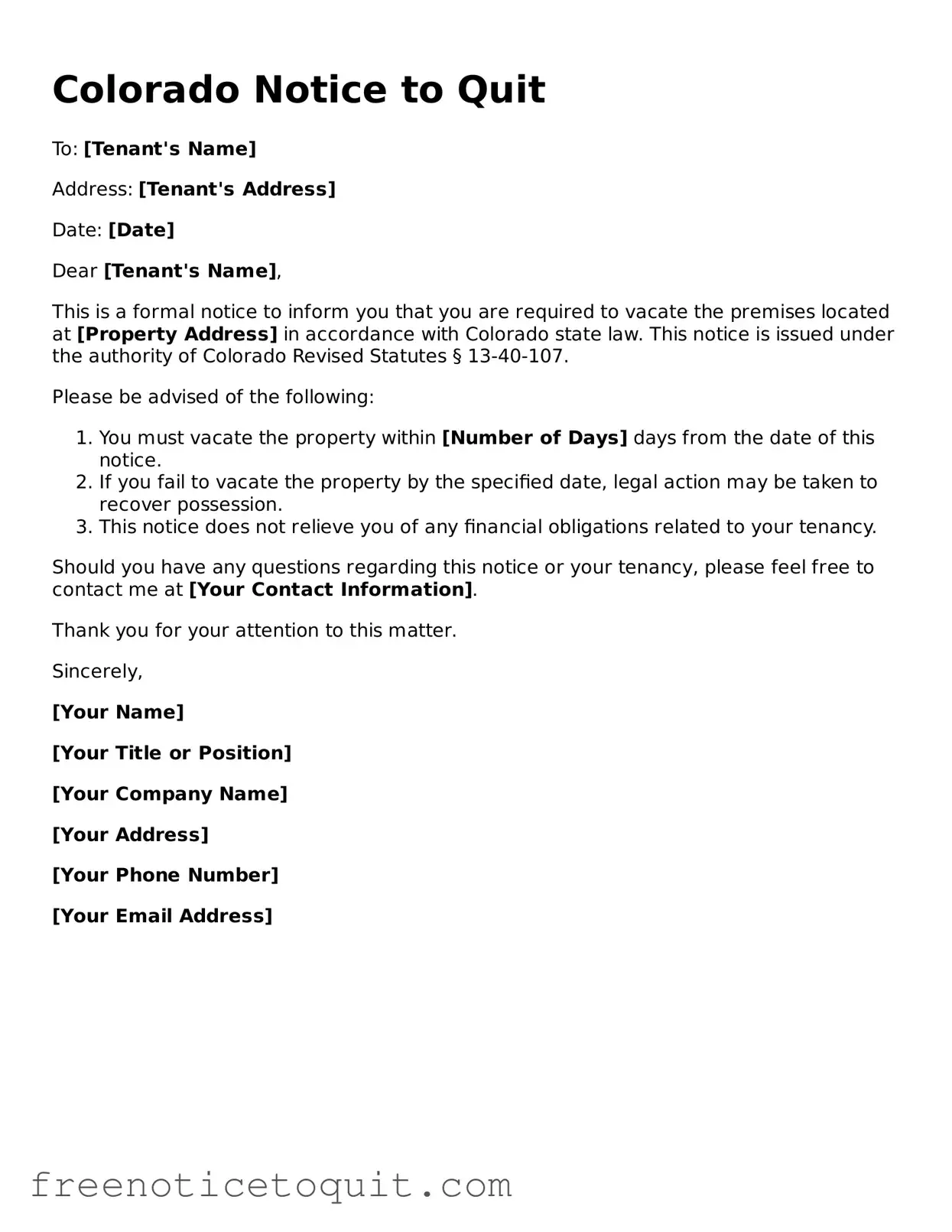
Colorado Notice to Quit Sample

Colorado Notice to Quit

To: [Tenant's Name]

Address: [Tenant's Address]

Date: [Date]

Dear [Tenant's Name],

This is a formal notice to inform you that you are required to vacate the premises located at [Property Address] in accordance with Colorado state law. This notice is issued under the authority of Colorado Revised Statutes § 13-40-107.

Please be advised of the following:

  1. You must vacate the property within [Number of Days] days from the date of this notice.
  2. If you fail to vacate the property by the specified date, legal action may be taken to recover possession.
  3. This notice does not relieve you of any financial obligations related to your tenancy.

Should you have any questions regarding this notice or your tenancy, please feel free to contact me at [Your Contact Information].

Thank you for your attention to this matter.

Sincerely,

[Your Name]

[Your Title or Position]

[Your Company Name]

[Your Address]

[Your Phone Number]

[Your Email Address]

PDF Data

Fact Name Description
Purpose The Colorado Notice to Quit form is used by landlords to inform tenants that they must vacate the rental property.
Governing Law This form is governed by the Colorado Revised Statutes, specifically Title 13, Article 40, which covers landlord-tenant relationships.
Notice Period Depending on the reason for the eviction, the notice period can vary. Typically, a 10-day notice is required for non-payment of rent.
Delivery Methods The notice can be delivered in person, via certified mail, or posted on the property if the tenant cannot be reached.
Tenant Rights Tenants have the right to contest the eviction in court. They may respond to the notice and seek legal advice.
Form Requirements The form must include specific details such as the tenant's name, address, and the reason for the eviction.
Legal Consequences Failure to comply with the notice may lead to legal action, allowing landlords to seek eviction through the court system.
Additional Resources Landlords and tenants can access resources through the Colorado Department of Local Affairs for guidance on the eviction process.

Instructions on Utilizing Colorado Notice to Quit

Once you have the Colorado Notice to Quit form in hand, it’s time to fill it out accurately. This form is essential for landlords who need to notify tenants about the termination of a lease. After completing the form, you will need to deliver it to the tenant according to the legal requirements.

  1. Begin by entering the date at the top of the form. This should be the date you are filling out the notice.
  2. Fill in your name and address as the landlord. Make sure to provide accurate contact information.
  3. Next, include the tenant’s name and the address of the rental property. Double-check for any spelling errors.
  4. Specify the reason for the notice. This could be due to non-payment of rent, lease violations, or other applicable reasons.
  5. Clearly state the amount of time the tenant has to vacate the property. This timeframe depends on the reason for the notice, so ensure it aligns with Colorado law.
  6. Sign the form at the bottom. Your signature confirms that you are the landlord and that the information provided is accurate.
  7. Make a copy of the completed form for your records before serving it to the tenant.

FAQ

What is a Colorado Notice to Quit form?

The Colorado Notice to Quit form is a legal document that a landlord uses to inform a tenant that they must vacate the rental property. This form is typically used in situations where the tenant has violated the lease agreement or has not paid rent. It serves as a formal notification of the landlord's intent to terminate the tenancy.

When should a landlord use a Notice to Quit?

A landlord should use a Notice to Quit when a tenant fails to comply with the terms of the lease, such as non-payment of rent, lease violations, or if the lease has expired. The notice provides the tenant with a specific timeframe to vacate the premises, which varies depending on the reason for the notice.

What information must be included in the Notice to Quit?

The Notice to Quit must include the tenant's name, the address of the rental property, the reason for the notice, and the date by which the tenant must vacate. It is also important to provide details about any lease violations or outstanding rent, as well as the landlord's contact information.

How much notice is required before a tenant must vacate?

The required notice period can vary based on the reason for the eviction. For non-payment of rent, landlords must typically provide a 10-day notice. For lease violations, a 5-day notice may be sufficient. If the lease has expired, a 30-day notice is generally required. Always check local laws for specific requirements.

Can a tenant contest a Notice to Quit?

Yes, a tenant can contest a Notice to Quit. If a tenant believes the notice is unjust or that they have rectified the issue, they may respond to the landlord in writing or seek legal advice. Contesting the notice may involve presenting evidence or documentation to support their case.

What happens if a tenant does not comply with the Notice to Quit?

If a tenant does not comply with the Notice to Quit, the landlord may proceed with legal action to evict the tenant. This process typically involves filing an eviction lawsuit in court. It is important for landlords to follow the proper legal procedures to avoid complications.

Is it necessary to have the Notice to Quit notarized?

No, it is not necessary for the Notice to Quit to be notarized. However, it is recommended that the landlord keep a copy of the notice and document how and when it was delivered to the tenant. This can be useful in case of future disputes.
Common mistakes

  1. Failing to provide the correct tenant name. Ensure that the name matches the lease agreement.

  2. Not including the complete address of the rental property. The full address should be accurate to avoid confusion.

  3. Omitting the date of the notice. This date is crucial for establishing the timeline for the tenant’s response.

  4. Not specifying the reason for the notice. Clearly state the grounds for eviction to comply with legal requirements.

  5. Using vague language. Be clear and specific about the issues leading to the notice.

  6. Failing to sign the form. The notice must be signed by the landlord or authorized agent.

  7. Not providing a contact method. Include a phone number or email for the tenant to reach out if needed.

  8. Incorrectly stating the timeframe for compliance. Ensure that the notice complies with state laws regarding the required notice period.

  9. Neglecting to keep a copy of the notice for records. Always retain a copy for your own documentation.

  10. Not delivering the notice properly. Follow the legal requirements for serving the notice to the tenant.

Documents used along the form

When dealing with rental agreements and potential evictions in Colorado, the Notice to Quit form is just one of several important documents that may come into play. Understanding these forms can help ensure a smoother process for both landlords and tenants. Below is a list of other forms and documents that are often used in conjunction with the Notice to Quit.

  • Lease Agreement: This is a contract between the landlord and tenant that outlines the terms of the rental arrangement, including rent amount, duration, and responsibilities of both parties.
  • Notice of Non-Renewal: This document informs a tenant that their lease will not be renewed at the end of its term, providing them with a clear timeline for vacating the property.
  • Eviction Complaint: If a tenant does not comply with the Notice to Quit, the landlord may file an eviction complaint with the court, formally initiating the eviction process.
  • Summons: This document is served to the tenant along with the eviction complaint, notifying them of the court date and their right to respond.
  • Answer to Eviction Complaint: The tenant can submit this document to the court to contest the eviction, outlining their reasons for staying in the property.
  • Judgment for Possession: If the court rules in favor of the landlord, this document grants the landlord legal possession of the rental property.
  • Writ of Possession: This legal order allows law enforcement to remove the tenant from the property if they do not leave voluntarily after the eviction judgment.
  • Security Deposit Return Form: After a tenant vacates, this form details the return of the security deposit, including any deductions for damages or unpaid rent.
  • Move-Out Inspection Checklist: This document helps both landlords and tenants assess the condition of the property upon move-out, ensuring transparency regarding any damages.

Each of these documents plays a vital role in the rental and eviction process. Familiarity with them can help both landlords and tenants navigate their rights and responsibilities more effectively. Always consider seeking professional advice if you have questions about specific situations or documents.

Similar forms

The Colorado Notice to Quit form is similar to the Eviction Notice, which is commonly used in many states. An Eviction Notice serves as a formal communication from a landlord to a tenant, indicating that the tenant must vacate the property by a specific date. Like the Notice to Quit, it outlines the reasons for the eviction, such as non-payment of rent or lease violations. Both documents are essential in the eviction process, as they provide the tenant with a clear understanding of the situation and the necessary steps they need to take.

Another document that resembles the Colorado Notice to Quit is the Lease Termination Letter. This letter is typically issued by either the landlord or the tenant to formally end a rental agreement. Similar to the Notice to Quit, it specifies the date by which the tenant must vacate the property. The Lease Termination Letter can be used for various reasons, including the end of a lease term or a mutual agreement to terminate the lease early. Both documents aim to provide clarity and prevent misunderstandings between the parties involved.

The Pay or Quit Notice is also comparable to the Colorado Notice to Quit. This notice is issued when a tenant has failed to pay rent on time. It provides the tenant with a specific timeframe to either pay the overdue rent or vacate the property. Like the Notice to Quit, the Pay or Quit Notice is a crucial step in the eviction process, ensuring that the tenant is informed of their obligations and the consequences of not meeting them.

The Cure or Quit Notice shares similarities with the Colorado Notice to Quit as well. This document is used when a tenant violates a term of their lease agreement, such as having unauthorized pets or causing property damage. The Cure or Quit Notice gives the tenant a chance to remedy the situation within a specified timeframe. If the tenant fails to address the issue, they may be required to vacate the premises, much like what is outlined in the Notice to Quit.

The Notice of Default is another document that bears resemblance to the Colorado Notice to Quit. This notice is often used in the context of mortgage agreements, informing a borrower that they have defaulted on their loan payments. While it primarily applies to homeownership, it serves a similar purpose by notifying the recipient of their failure to meet obligations and the potential consequences. Both notices aim to prompt action and encourage resolution before further legal steps are taken.

The Rental Agreement Termination Notice is also akin to the Colorado Notice to Quit. This notice is used to inform a tenant that their rental agreement will not be renewed at the end of the lease term. It provides the tenant with a clear timeframe to vacate the property. Like the Notice to Quit, this document is designed to prevent confusion and ensure that both parties are on the same page regarding the end of the tenancy.

Lastly, the Notice of Intent to Vacate is similar to the Colorado Notice to Quit. This document is typically issued by the tenant to inform the landlord of their intention to leave the property. It outlines the planned departure date and may include reasons for leaving. While it is the tenant's initiative, it serves a similar purpose by facilitating clear communication between the landlord and tenant, much like the Notice to Quit does in the opposite direction.

Dos and Don'ts

When filling out the Colorado Notice to Quit form, it’s important to approach the task with care. Here are five things you should and shouldn't do to ensure the process goes smoothly:

  • Do make sure you understand the reason for the notice. Clarity on the grounds for eviction is crucial.
  • Don't use vague language. Be specific about the issues that led to the decision to file the notice.
  • Do include all necessary details. This includes the tenant's name, address, and the date of the notice.
  • Don't forget to sign and date the form. An unsigned notice may not be considered valid.
  • Do keep a copy of the completed form for your records. Documentation is key in any legal process.

By following these guidelines, you can navigate the process more effectively and ensure that your Notice to Quit is properly filled out.

Misconceptions

When dealing with the Colorado Notice to Quit form, several misconceptions can lead to confusion for both landlords and tenants. Understanding these misconceptions is essential for navigating the eviction process effectively.

  • Misconception 1: The Notice to Quit is an eviction notice.
  • Many people believe that the Notice to Quit is the same as an eviction notice. In reality, it is a preliminary step that informs the tenant of the landlord's intention to terminate the lease. The actual eviction process requires additional legal steps.

  • Misconception 2: Tenants have no rights after receiving a Notice to Quit.
  • This is not true. Tenants still have rights after receiving the notice. They can respond, negotiate, or even contest the notice in court, depending on the circumstances surrounding their tenancy.

  • Misconception 3: A Notice to Quit must be delivered in person.
  • While personal delivery is one method, it is not the only way to serve a Notice to Quit. Landlords can also send the notice via certified mail or post it on the tenant's door, following state guidelines.

  • Misconception 4: The Notice to Quit has a universal timeline.
  • The timeline for a Notice to Quit can vary based on the reason for the notice and local laws. Different circumstances, such as non-payment of rent or lease violations, may require different notice periods.

Key takeaways

When dealing with the Colorado Notice to Quit form, there are several important points to keep in mind. This form serves as a formal notification to tenants regarding the termination of their lease. Below are key takeaways to consider:

  • Understand the Purpose: The Notice to Quit is primarily used to inform tenants that they must vacate the rental property by a specified date. This is often due to lease violations or non-payment of rent.
  • Know the Required Information: Ensure that the form includes essential details such as the tenant's name, the address of the rental property, and the reason for the notice. Clarity is crucial for avoiding disputes.
  • Delivery Methods Matter: The Notice must be delivered to the tenant in a manner that complies with Colorado law. This can include personal delivery, certified mail, or posting on the property, depending on the situation.
  • Adhere to Timeframes: Be aware of the required notice periods based on the reason for the eviction. Different situations may require different lengths of time before the tenant must vacate.

Following these guidelines can help ensure that the process is handled correctly and efficiently.

Printable Notice to Quit Template for the State of Colorado

Open Notice to Quit Editor Here