Printable Notice to Quit Template for the State of Tennessee Open Notice to Quit Editor Here

Printable Notice to Quit Template for the State of Tennessee

The Tennessee Notice to Quit form is an official document that a landlord uses to inform a tenant that they must vacate the rental property. This notice typically outlines the reasons for the eviction and provides a specific timeframe for the tenant to leave. Understanding this form is essential for both landlords and tenants to ensure compliance with state laws and protect their rights.

The Tennessee Notice to Quit form serves as a crucial document in the landlord-tenant relationship, particularly when a landlord seeks to terminate a rental agreement. This form outlines the necessary steps a landlord must take to inform a tenant that they must vacate the property, typically due to non-payment of rent or violation of lease terms. It includes essential details such as the tenant's name, the address of the rental property, and the specific reasons for the eviction. The notice must also specify the timeframe within which the tenant is expected to vacate, which can vary depending on the circumstances. Understanding the requirements and implications of this form is vital for both landlords and tenants, as it ensures that the eviction process adheres to Tennessee law. A properly executed Notice to Quit can help prevent disputes and facilitate a smoother transition, while a poorly handled notice may lead to legal complications and delays. Therefore, familiarity with this form is important for anyone involved in rental agreements in Tennessee.

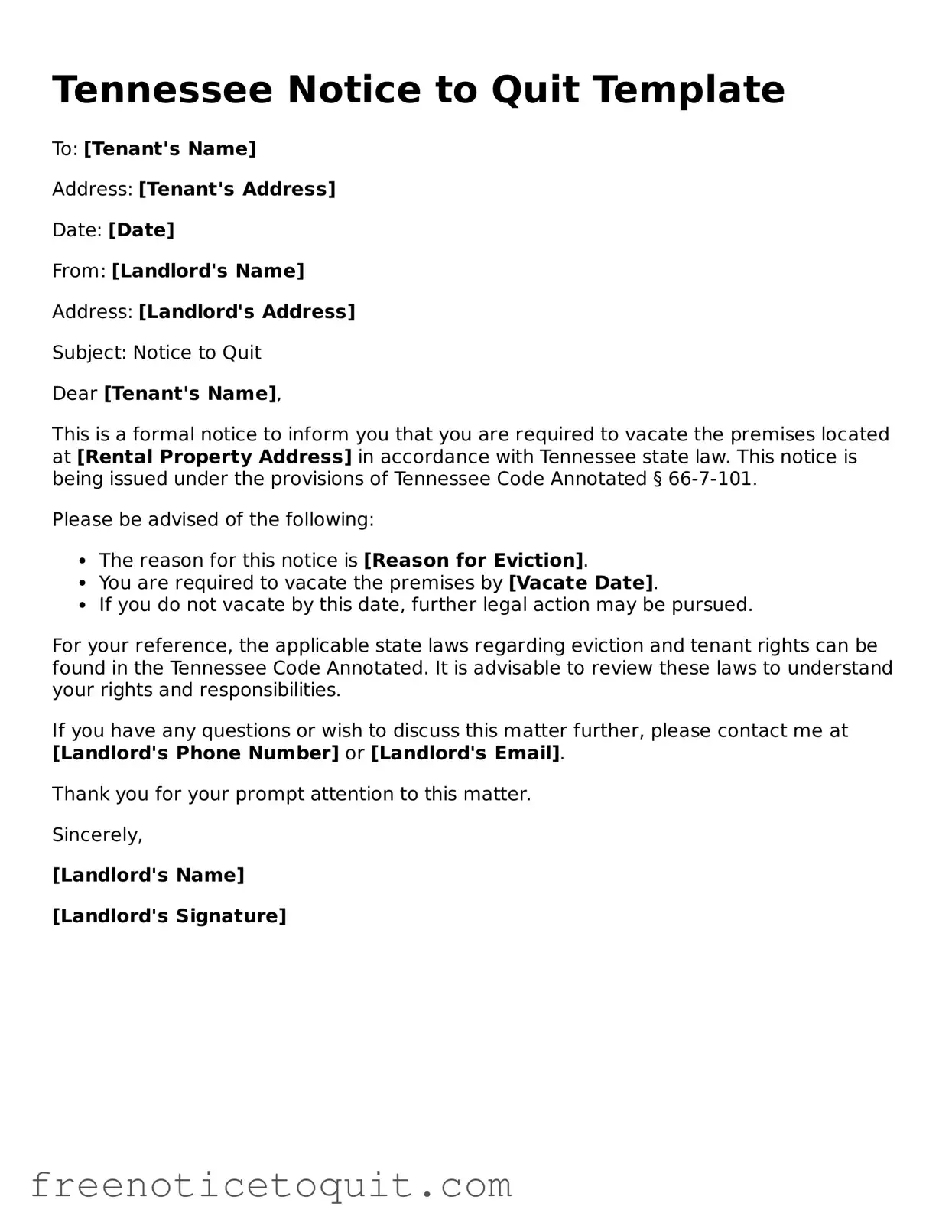
Tennessee Notice to Quit Sample

Tennessee Notice to Quit Template

To: [Tenant's Name]

Address: [Tenant's Address]

Date: [Date]

From: [Landlord's Name]

Address: [Landlord's Address]

Subject: Notice to Quit

Dear [Tenant's Name],

This is a formal notice to inform you that you are required to vacate the premises located at [Rental Property Address] in accordance with Tennessee state law. This notice is being issued under the provisions of Tennessee Code Annotated § 66-7-101.

Please be advised of the following:

  • The reason for this notice is [Reason for Eviction].
  • You are required to vacate the premises by [Vacate Date].
  • If you do not vacate by this date, further legal action may be pursued.

For your reference, the applicable state laws regarding eviction and tenant rights can be found in the Tennessee Code Annotated. It is advisable to review these laws to understand your rights and responsibilities.

If you have any questions or wish to discuss this matter further, please contact me at [Landlord's Phone Number] or [Landlord's Email].

Thank you for your prompt attention to this matter.

Sincerely,

[Landlord's Name]

[Landlord's Signature]

PDF Data

Fact Name Details
Purpose The Tennessee Notice to Quit form is used by landlords to inform tenants that they must vacate the rental property.
Governing Law This form is governed by Tennessee Code Annotated, Title 66, Chapter 28.
Notice Period The required notice period can vary depending on the reason for eviction, typically ranging from 14 to 30 days.
Delivery Method The notice can be delivered in person, by certified mail, or by posting it on the rental property.
Tenant's Rights Tenants have the right to contest the eviction in court if they believe the notice is unjustified.
Required Information The notice must include the tenant's name, the address of the rental property, and the reason for eviction.
Signature Requirement The landlord or their authorized agent must sign the notice to make it valid.
Legal Consequences If the tenant does not vacate by the specified date, the landlord may proceed with legal eviction actions.
Form Availability The Tennessee Notice to Quit form can typically be obtained from legal aid organizations or online legal resources.

Instructions on Utilizing Tennessee Notice to Quit

After obtaining the Tennessee Notice to Quit form, you will need to fill it out accurately to ensure that it meets the legal requirements. This form serves as a formal notification to a tenant regarding the termination of their lease. Once completed, it must be delivered to the tenant in accordance with Tennessee law.

  1. Begin by entering the date at the top of the form. This is the date you are issuing the notice.
  2. Next, provide your name and address in the designated fields. This identifies you as the landlord or property owner.
  3. In the following section, write the tenant's name and address. Make sure to spell everything correctly to avoid confusion.
  4. Clearly state the reason for the notice. This could be non-payment of rent, lease violations, or other valid reasons for terminating the lease.
  5. Specify the time frame you are giving the tenant to vacate the property. Tennessee law typically requires a minimum notice period depending on the reason for eviction.
  6. Sign the form at the bottom. Your signature is essential for the notice to be considered valid.
  7. Finally, make a copy of the completed form for your records before delivering it to the tenant.

FAQ

What is a Tennessee Notice to Quit form?

The Tennessee Notice to Quit form is a legal document used by landlords to inform tenants that they must vacate the rental property. This notice is typically issued when a tenant has violated the lease agreement or has not paid rent. It serves as a formal communication to initiate the eviction process if necessary.

When should a landlord use the Notice to Quit?

A landlord should use the Notice to Quit when a tenant fails to comply with lease terms, such as non-payment of rent, lease violations, or when the lease term has ended. The notice provides the tenant with an opportunity to correct the issue or vacate the premises within a specified timeframe.

How much notice must be given in a Tennessee Notice to Quit?

The amount of notice required depends on the reason for the eviction. For non-payment of rent, landlords must provide a 14-day notice. For lease violations, a 30-day notice is typically required. It's important to specify the reason for the notice clearly.

Can a tenant contest a Notice to Quit?

Yes, a tenant can contest a Notice to Quit. If a tenant believes the notice was issued incorrectly or that they have rectified the issue, they can respond to the landlord or seek legal advice. This may involve presenting their case in court if the eviction process proceeds.

What information should be included in the Notice to Quit?

The Notice to Quit should include the tenant's name, the address of the rental property, the reason for the notice, and the deadline for vacating the property. It should also include the date the notice was issued and the landlord's contact information.

Is the Notice to Quit form required to be notarized?

No, the Notice to Quit does not need to be notarized. However, it should be signed by the landlord or their authorized agent. Keeping a copy of the notice for your records is advisable.

What happens if the tenant does not leave by the deadline?

If the tenant does not vacate the property by the deadline specified in the Notice to Quit, the landlord can file for eviction in court. This legal process will require the landlord to prove their case and may involve a hearing where both parties can present their arguments.

Can a tenant be evicted without a Notice to Quit?

In Tennessee, a landlord cannot legally evict a tenant without first providing a Notice to Quit, unless there are specific circumstances such as criminal activity. Following the proper legal process is essential to avoid potential legal issues.

Where can I obtain a Tennessee Notice to Quit form?

A Tennessee Notice to Quit form can be obtained from various sources, including online legal form providers, local legal aid offices, or real estate associations. It's important to ensure that the form complies with Tennessee state laws and regulations.
Common mistakes

  1. Failing to provide accurate tenant information. It's crucial to include the full name of the tenant and the correct address of the rental property. Any mistakes here can lead to confusion and delays.

  2. Not specifying the reason for the notice. In Tennessee, it’s important to clearly state why the notice is being issued, whether it’s for non-payment of rent or another reason. This clarity helps prevent disputes.

  3. Neglecting to include the date of the notice. The date is essential as it marks the beginning of the notice period. Without it, the notice may be deemed invalid.

  4. Overlooking the required notice period. Tennessee law specifies how much time a tenant must be given to vacate. Not adhering to this timeframe can result in legal complications.

  5. Not signing the form. A signature is necessary to validate the notice. Without it, the notice may not be legally binding.

Documents used along the form

The Tennessee Notice to Quit form is an essential document in the eviction process, signaling to tenants that they must vacate the premises. However, several other forms and documents often accompany it to ensure that the eviction process is carried out legally and effectively. Below are some of the key documents that may be used alongside the Notice to Quit.

  • Lease Agreement: This document outlines the terms and conditions of the rental arrangement between the landlord and tenant. It includes details such as rent amount, duration of the lease, and responsibilities of both parties.
  • Notice of Non-Payment: This notice is issued when a tenant fails to pay rent on time. It typically gives the tenant a specified period to pay the overdue rent before further action, such as eviction, is taken.
  • Eviction Complaint: If a landlord decides to proceed with eviction after the Notice to Quit, they must file an eviction complaint in court. This document formally initiates the legal process and outlines the reasons for eviction.
  • Judgment Order: After a court hearing, if the landlord prevails, the court issues a judgment order. This document grants the landlord the right to regain possession of the property and may include instructions for the sheriff to carry out the eviction.

Understanding these documents helps both landlords and tenants navigate the eviction process more effectively. Each form plays a specific role in ensuring that the rights of both parties are respected and that the process adheres to legal standards.

Similar forms

The Tennessee Notice to Quit form is similar to the Eviction Notice in many states. Both documents serve as formal notifications to tenants, indicating that they must vacate the rental property. While the specific requirements can vary by state, the essence remains the same: a landlord must provide a clear and documented reason for the eviction, often related to non-payment of rent or lease violations. Just like the Notice to Quit, the Eviction Notice must adhere to local laws regarding notice periods and delivery methods.

Another document that resembles the Tennessee Notice to Quit is the Lease Termination Letter. This letter is often used when a landlord or tenant wishes to end a rental agreement without cause. Similar to the Notice to Quit, it outlines the intention to terminate the lease and specifies the date by which the tenant must vacate the premises. Both documents require clear communication and adherence to the terms of the lease agreement, ensuring that both parties understand their rights and responsibilities.

The Demand for Possession is another document that shares similarities with the Tennessee Notice to Quit. This legal notice is typically used after a tenant has failed to pay rent or violated lease terms. It demands that the tenant vacate the property, often within a specified timeframe. Like the Notice to Quit, it serves as a precursor to formal eviction proceedings, emphasizing the urgency of the situation and the need for the tenant to respond promptly.

The Notice of Non-Renewal is also akin to the Tennessee Notice to Quit. This document is used when a landlord does not intend to renew a lease agreement at its expiration. It informs the tenant that they must vacate the property by the end of the lease term. Both the Notice of Non-Renewal and the Notice to Quit require timely delivery and clear communication to ensure that tenants are aware of their obligations and the timeline for moving out.

The 30-Day Notice to Vacate is yet another document that shares common ground with the Tennessee Notice to Quit. This notice is often given by either party to terminate a month-to-month rental agreement. It provides a clear timeframe for the tenant to vacate the property, similar to the Notice to Quit. Both documents aim to establish a mutual understanding between landlord and tenant regarding the end of the tenancy, ensuring that all parties are informed and prepared for the transition.

Lastly, the Notice of Lease Violation is similar to the Tennessee Notice to Quit in that it addresses issues related to the tenant's conduct. This document alerts the tenant to specific violations of the lease agreement, such as unauthorized pets or excessive noise. It often provides a timeframe for the tenant to correct the violation or face eviction. Both notices underscore the importance of adhering to lease terms and the potential consequences of non-compliance.

Dos and Don'ts

When filling out the Tennessee Notice to Quit form, it is essential to approach the process with care. This form serves as a formal notice to a tenant, indicating that they must vacate the rental property. Below is a list of important dos and don'ts to consider.

  • Do provide accurate information about the tenant and the rental property.
  • Do specify the reason for the notice clearly.
  • Do include the date by which the tenant must vacate the property.
  • Do keep a copy of the completed form for your records.
  • Don't use vague language that could confuse the tenant.
  • Don't forget to sign and date the notice.
  • Don't deliver the notice in a way that does not comply with state laws.

By adhering to these guidelines, you can ensure that the process is handled smoothly and respectfully. Proper communication is key in these situations, and clarity can help prevent misunderstandings.

Misconceptions

Understanding the Tennessee Notice to Quit form is essential for both landlords and tenants. However, several misconceptions often arise regarding its use and implications. Below is a list of common misunderstandings.

  • It is the same as an eviction notice. Many people believe that the Notice to Quit is an eviction notice. In reality, it is a preliminary step that informs tenants of their lease violations or the need to vacate the property.
  • It can be issued without cause. Some think landlords can issue a Notice to Quit for any reason. However, valid reasons must exist, such as non-payment of rent or lease violations.
  • There is no specific format required. While some may assume any written notice suffices, Tennessee law requires specific language and information to be included in the Notice to Quit for it to be effective.
  • It does not require delivery confirmation. Many believe that simply sending the Notice to Quit is enough. In fact, landlords must ensure that the notice is delivered properly, which may include mailing it or delivering it in person.
  • Tenants cannot respond to it. Some tenants think they have no recourse once they receive a Notice to Quit. In truth, tenants can dispute the notice and may have the opportunity to rectify the situation before eviction proceedings begin.
  • It applies to all rental agreements. There is a misconception that the Notice to Quit is applicable to all types of rental agreements. In reality, the rules may vary depending on whether the lease is written, oral, or month-to-month.
  • It must be filed in court. Some individuals believe that the Notice to Quit needs to be filed with the court. However, it is simply a notice that does not require court involvement until further action is taken.
  • It can be ignored by tenants. A common misunderstanding is that tenants can ignore a Notice to Quit without consequences. Ignoring the notice can lead to legal action and potential eviction.
  • It guarantees immediate eviction. Lastly, some think that receiving a Notice to Quit means eviction will happen right away. The process involves several steps, and tenants often have time to respond or remedy the issue.

Clarifying these misconceptions can help both landlords and tenants navigate the rental process more effectively and avoid unnecessary disputes.

Key takeaways

The Tennessee Notice to Quit form is an important document for landlords and tenants. Understanding its purpose and proper use can help facilitate a smoother transition in rental situations. Here are some key takeaways regarding this form:

  • The Notice to Quit is typically used by landlords to inform tenants that they must vacate the rental property.
  • It is essential to specify the reason for the eviction, whether it is due to non-payment of rent or lease violations.
  • The form must include the date by which the tenant is expected to leave the premises.
  • Landlords should ensure that the notice is delivered in accordance with Tennessee law, which may include personal delivery or certified mail.
  • Tenants have the right to respond to the notice, and they may seek legal advice if they believe the eviction is unjust.
  • Failure to comply with the Notice to Quit can lead to formal eviction proceedings in court.
  • It is advisable for landlords to keep a copy of the Notice to Quit for their records.
  • Tenants should read the notice carefully and understand their rights and responsibilities outlined within it.
  • Both parties should be aware that this notice is just one step in the eviction process and does not guarantee immediate removal from the property.

Understanding these points can help both landlords and tenants navigate the complexities of rental agreements and potential evictions in Tennessee.

Printable Notice to Quit Template for the State of Tennessee

Open Notice to Quit Editor Here